Rwanda, Uganda and Kenya agreed to begin issuance of a single tourist visa, aimed at easing and promoting tourism among the three states. The resolution to issue a single visa to tourists came after delegates from the three countries held a two-day long meeting in Kigali on August 1 and 2.

They agreed to charge USD100 per tourist intending to visit the three countries. Each of the three states will claim USD30 from the Single Visa fees while the balance of  USD10 will be set aside for technical operations. The fee would be paid at the point of entry into any of the three countries for up to 90 days.


chate-in-ethio.jpg

Kenyan traders of “khat”, a stimulus quite common in East Africa, called for the expulsion of British troops and farmers and a boycott of U.K. products in retaliation to a planned ban on trade of the leaves.

U.K. Home Secretary Theresa May told parliament on July 3 that “khat” will be categorized as a Class C drug, leading to jail terms of as long as two years for possession and 14 years for dealing in it.


ethiopia-post.jpg

Ethiopia is identified as one of the four African countries in PC16 – Post China 16: countries best suited to succeed China as the world’s low-cost, export-oriented economic hub, according to a projection by stratford, a renowned geopolitical intelligence firm. The report indicates, the international system opens the door to low-wage countries with appropriate infrastructure and sufficient order to do business. Low-wage countries seize the opportunity and climb upon the escalator of the international system and development.


The Ministry of Education (MoE) will soon start classifying private schools in the country into different categories based on a package adopted in March 2013. Schools will be categorized from level 1 through level 5 based on standards included in the new package. The new document entitled National Schools Classification Package, is an extension of the quality education package that the Ministry introduced in 2006.


quit-1.jpg

Gezahegn Dugassa Leta, director for Banking Products and Technology Innovation at Awash International Bank, on Ethiopia Banking and ICT Summit, 2013, which was held at Sheraton Addis on August 2, 2013, referring to the challenges Ethiopia’s banking sector will face when it is fully engaged in internet and mobile banking. “You have to be ready well before you start it,” he added.


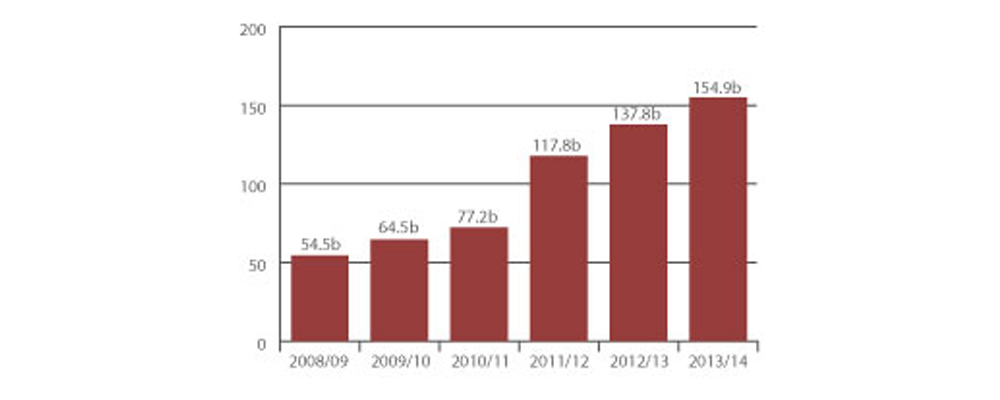
The house of peoples representatives has approved a total budget of ETB 154.9 billion for the 2013/2014 fiscal year (2006 EFY). From which a substantial amount of it, ETB 64.3 billion, which is about 41.5 pct of the total budget is allocated to capital expenditures. Whereas the budget subsidy to regional states is the next biggest share amounting ETB 43.1 billion or 37.5 pct of the total budget. The additional 21 pct goes to the recurrent budget ETB 32.5 billion, and to the Millennium Development Goals (MDGs) ETB 15 billion.


Federal_Budget.jpg

Ethiopia’s federal budget over the last five years has shown an average increase of 20 pct. In 2009/10 and 20010/11 the budgets grew nearly 20 pct to ETB 64.5 and ETB 77.2 billion respectively.

At the first year of the GTP the federal budget has leaped to ETB 117.8 billion recording remarkable growth of almost 40 pct. In the previous year the budget has increased to 137.8 billion with 13.6 pct growth. Similarly the next year’s 2013/14 proposed budget has shown a 12.3 pct growth.


Ethiopian Business Review | EBR is a first-class and high-quality monthly business magazine offering enlightenment to readers and a platform for partners.


2Q69+2MM, Jomo Kenyatta St, Addis Ababa

Tsehay Messay Building

Contact Us

+251 961 41 41 41