
Ethiopia, DRC, Nigeria Face Up to $780 Million in Aid Losses as Humanitarian Funding Drops 42%, IMF Reveals
EBR_News Apr 17, 2026
Betegbar Yaregal
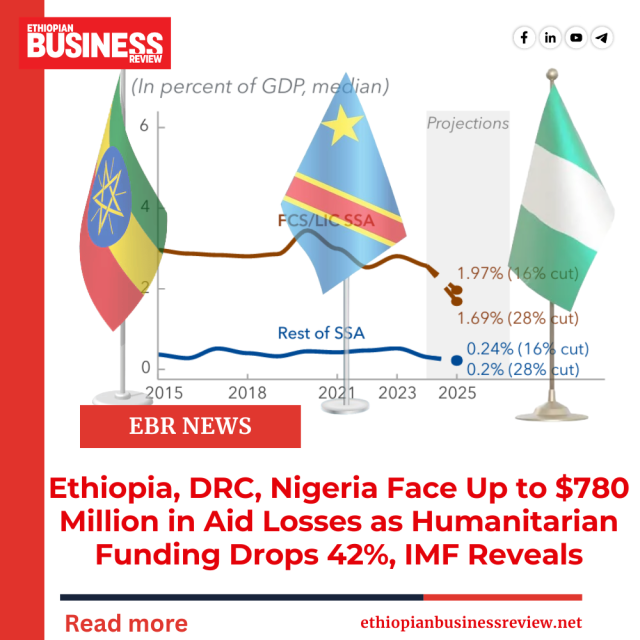
Ethiopia, the Democratic Republic of the Congo, and Nigeria are set to lose between $240 million and $780 million each in official development assistance after African bilateral aid budgets contracted by 16 to 28 percent in 2025, a reduction of $4 to $7 billion, according to the International Monetary Fund’s April 2026 Regional Economic Outlook.
The report, released during the IMF Spring Meetings in Washington, reveals that the closure of the United States Agency for International Development (USAID), substantial cuts to US development budgets announced in January 2025, and funding reductions from other major donors including France, Germany, and the United Kingdom have triggered an aid shock unlike any seen before.
Unlike past episodes where aid declines were often country-specific or cyclical, this contraction is “donor-driven, simultaneous across countries, and unfolding with minimal warning,” the IMF states.
Initial estimates indicate that humanitarian aid flows to sub-Saharan Africa dropped by 42 percent in 2025 compared to 2024 levels, according to UNOCHA data cited in the report. Chad, Africa’s largest host country for refugees per capita, could see its aid receipts halved in the coming year, severely crippling life-saving assistance for both refugee camps and its own population.
The United Nations Office for the Coordination of Humanitarian Affairs estimates that less than half of the people in need of humanitarian assistance can be reached with available resources in 2026. An estimated three million children in sub-Saharan Africa may be pushed out of school, and 75 million children globally may miss routine vaccinations over the next five years, the report warns.
The 2025 bilateral cuts are likely only the first wave, the IMF cautions. Most bilateral donors plan aid on multiyear cycles, meaning further reductions will occur when new programming periods begin. Multilateral agencies, traditionally shock absorbers for the region, face their own steep budget cuts following decreased contributions from bilateral donors. The World Food Programme, UNICEF, and the World Health Organization project 34 percent, 27 percent, and 39 percent less funding in the coming years than in 2023-24, respectively.
Aid cuts reinforce the criticality of domestic revenue mobilization in sub-Saharan Africa. Sub-Saharan Africa has the lowest tax-to-GDP ratio in the world, with the median country collecting 13.8 percent of GDP. Improved tax administration and policy reforms can raise this figure, but doing so requires strengthening technical capacity and building public support and trust.
The countries most affected by the cuts tend to be those already facing multiple sources of vulnerability, including conflict, insurgency, high poverty rates, and political instability.
The report notes that low-income countries and fragile states, where aid previously financed health, education, and humanitarian programs, will bear the heaviest burden.
 Betegbar Yaregal