

 Ethiopian Business Review
Ever since Donald Trump became the President of the United States of America a year ago, the fate of countries that receive large amounts of aid money has been hanging in the balance. The US President’s campaign promise to cut back foreign aid has caused fear, which was exacerbated in the last days of 2017 when the president threatened to withhold aid to countries who voted in favor of the United Nations resolution rejecting the United Sates’ recognition of Jerusalem as the capital of Israel.
 Zekarias Amsalu
Among the common risks investors interested in African countries like Ethiopia often mention are investment protection, dividend (profit) and capital repatriation. A typical concern investors bring up at deal sourcing discussions may include details of a ‘forex-crunch’ they had heard about either from local operators, or fellow investors. Whether these fears be real, perceived, or imagined, what matters is that they make an impact in investors’ minds.
 Michael Spence (PhD)
Most of the global economy is now subject to positive economic trends: unemployment is falling, output gaps are closing, growth is picking up, and, for reasons that are not yet clear, inflation remains below the major central banks’ targets. On the other hand, productivity growth remains weak, income inequality is increasing, and less educated workers are struggling to find attractive employment opportunities.
 J. Bradford DeLong
There are 17 United Nations Sustainable Development Goals (SDGs), which aim to tackle problems including poverty, hunger, disease, inequality, climate change, ecological degradation, and many others in between. Clearly, 17 is too many. As Frederick the Great supposedly said, “He who defends everything defends nothing.” Similarly, those who emphasize everything emphasize nothing.

 Ashenafi Endale
Cursed Business, Blessed Money
Khat has become one of Ethiopia’s most lucrative exports, recently surpassing even coffee. However, the impact of Khat becoming more profitable is that farmers are starting to steer away from traditional staple crops in favor of growing it. Even so, the government still doesn’t have a cohesive strategy or supports to ensure that the country is getting the greatest possible benefits, as EBR’s Ashenafi Endale explores.

Until recently, the construction sector has been instrumental in catapulting the nation to higher levels of development. The sector has been catalyzing the burgeoning of all the economic sub sectors such as modern agriculture and manufacturing. However, the construction sector is slowing down nowadays due to various factors such as political unrest and shortages of construction machineries as well as scarcity of finance and hard currency. On top of this, the sector is now confronting another hurdle: shortage of skilled manpower available to handle the maintenance and repair of construction machineries, as EBR’s Ashenafi Endale explores.

 Menna Asrat
Addis Ababa has long been a friendly place for more dessert minded people. With cafes and bakeries on almost every corner catering to all kinds of tastes, sweets are a cherished part of everyday life. However, in the last few years, ice cream, an afterthought in cafes and relegates to the status of children’s treat, has started to make a comeback. With higher standards for quality, and more variety in flavour, ice cream has started to come back into the consciousness of city residents who have fond memories of it from their childhoods. New shops, dedicated solely to ice cream, have started to spread across the city, as EBR’s Menna Asrat reports.

Cut throat Price Competitions, Low Capital Base, & Poor Policy Threaten their Growth
Insurance is one of the key pillars of a modern economy. It contributes to mobilize savings, transfer risks and reduce financial losses.
The history of modern insurance in Ethiopia, especially the private sector driven one, is at its early stage. However, the sector is crippled with lack of innovative products and services. As a result, the industry lags far behind several African countries. The sector’s growth, especially in recent years, is marred with rising claims and declining premium rates. The stiff price based competition in the market contributed to this situation. EBR’s Ashenafi Endale explores the issue to offer this report.
 Hiwot Selalew
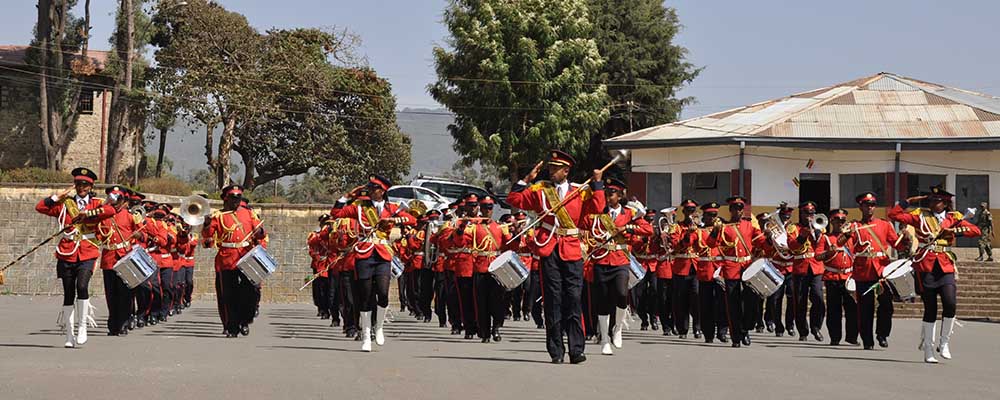
A marching band constitutes a group of musicians that perform while marching. It is common to see March bands adding the element of entertainment in different occasions. Most marching bands have attractive uniforms often of a military style. Instrument typically incorporated in a marching band includes brass, woodwind and percussion. In Ethiopia, marching bands have a history of more than 75 years.. The Defense and Federal Police March bands are the most known in the country. EBR’s Hiwot Selalew consulted professionals and documents to offer this report.

Although cotton is one of the oldest cultivated agricultural commodities in Ethiopia, recent trends show that the demand from textile factories is only met partially from local sources. Out of the three million hectare of land suitable for cotton, less than 10Pct is currently cultivated.
In order to reverse the situation, Ethiopia introduced a new cotton development strategy in October 2017. The strategy, which delineates targets and activities to be carried out in the next 15 years, foresees the growth of cotton production to satisfy local demand and engage in export. One of the institutions responsible for the implementation of the strategy is the Textile Industry Development Institute (TIDI). Yared Mesfin, Deputy Director General of TIDI talks to EBR.