Depression.jpg

Despite primarily being a health problem, COVID-19 has numerous economic, social and political attributes. The combined effect of the socio-economic problems of the pandemic, in turn, have the potential to raise some other health problems. With stay at home orders, high potential for social crisis, unemployment and perceived threat of losing loved ones during the pandemic, a suitable condition has been created for depression to rise. EBR’s Kiya Ali takes a closer look at the problem.


Like the rest of the world but perhaps more than most, the Coronavirus poses an unprecedented existential challenge to Ethiopia. If current projections of the spread of the pandemic hold, the country will see the gains from recent rapid growth, now totally wiped out, the poverty level more than doubled, its economy shattered, export revenues drastically reduced, its external debt servicing shooting to an unsustainable and dangerous level, its social and political order enormously tested and even threatened, and its population decimated by death, illness, hunger and famine.


The slowdown of manufacturing in China due to the corona virus (COVID-19) outbreak is disrupting world trade and could result in a USDUS50 billion decrease in exports across global value chains, according to a report published by UNCTAD on March 4, 2020. The most affected is the manufacturing sector, especially producers of precision instruments, machinery, automotive and communication equipments.


topic-85.jpg

When news of a new strain of Coronavirus came out of China almost four months ago, the world seems unimpressed with the potential danger it posed. It has, however, taken the invisible microbe less than three months to literally make the whole world its empire. Its social, economic and political impacts have poured water on other burning issues of the world and left them on the backburner. Especially the world economy has been hard hit by the pandemic. The fates of businesses and potentially billions of employees hangs by the balance. Different sectors of the Ethiopian economy have also faced the wrath of the invisible microbe. EBR’s Samson Berhane and Ashenafi Endale delve into the global, regional and national economic impacts and emergency measures.


Chocking-the-Life-Out-of-Plastics.jpg

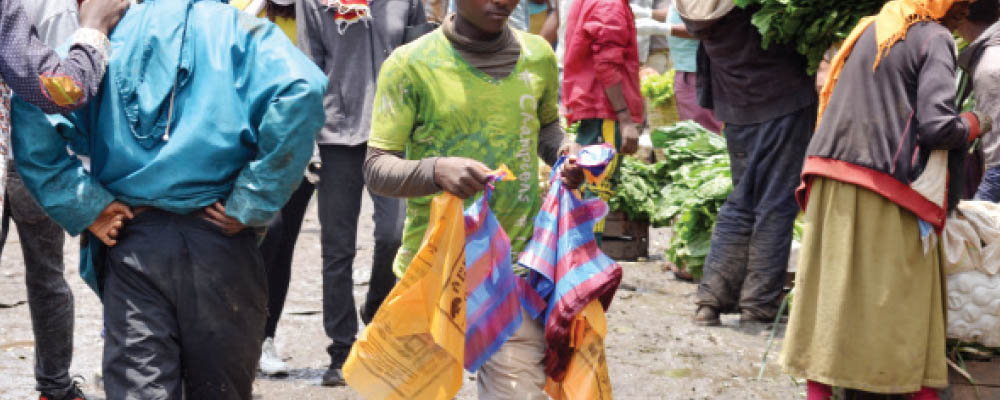
Using plastic bags is a common practice in Ethiopia, a country that aspires to build a carbon free economy by 2025. Although Ethiopia declared producing plastic bags of below 0.03mm illegal long ago, the proclamation has not been put into practice. Retailers openly trade bags below the recommended amount throughout Ethiopia. With that precedent in mind, the government has drafted a new law that totally bans plastic bags. While this is expected to be legislated in the next three months, producers complain such a measure would put them in a precarious situation. EBR’s Ashenafi Endale explores.


The-Uphill-Battle.jpg

The reliance on remittance has scaled up globally from household level to national economies following the massive workforce flow in the contemporary global economy. Ethiopia, a country that just woke up to this reality, has countless reasons to regard remittance as its biggest source of foreign currency. Especially in the last decade, remittance flows increased significantly surpassing export revenue. The annual remittance flow currently stands at USD5.3 billion. However, the annual remittance sent via official channels doesn’t match the huge number of Ethiopians residing abroad. EBR’s Ashenafi Endale investigates the reasons behind.


Fast-Forwarding-Evolution.jpg

The transformation of humanitarian organizations into financial institutions in 1997 was the beginning of operation of Micro Finance Institutions (MFIs) in Ethiopia. From then on, MFIs have showed remarkable progress in number, outreach, coverage and performance. Currently, 40 MFIs operating in the country serve close to 10 million clients nationwide while 15 more are in the making. Breaking the trend in the rest of the world, Ethiopia’s microfinance industry is born and raised in rural parts of the country. However, MFIs are currently conquering urban Ethiopia and providing credit especially for business establishments. Urbanites now make up close to 10Pct of the clientele of MFIs. The four pioneer MFIs, whose capital is way larger than most small and mid sized banks, are planning to mold themselves into conventional banks. On the other hand, the rest are pushing up their credit limits in order to capture the attention of the large segment of the unbanked population. Although most MFIs in Ethiopia have reached maturity and success, they are not immune from problems. EBR’s Ashenafi Endale reports.


The-Bumpy-Road-to-Affordable.jpg

Community Based Health Insurance (CBHI) is still an emerging concept for the majority of Ethiopians though it has been piloted for many years. However, the scheme is benefiting 22.5 million Ethiopians who are living under extreme poverty excluded from formal insurance schemes. Even in Addis Ababa, where the scheme started two years ago, close to 200,000 people are getting financial protection against the high cost of healthcare services. EBR’s Kiya Ali explores.


Addis-Ababas-Baby-Steps.jpg

There are no options in sight for Addis Ababa’s horizontal expansion now that border disputes with Oromia regional state have become one of the hottest political agenda in the country. This horizontally fixed landmass has, however, been receiving an unprecedented huge influx of rural urban migrants. With most of the city’s farm lands used up for constructing residential areas, residents of Africa’s capital are left to depend on regional states for the supply of agricultural products. EBR’s Ashenafi Endale looks into the problem and the fresh efforts being taken to avert the situation.


Ethiopian Business Review | EBR is a first-class and high-quality monthly business magazine offering enlightenment to readers and a platform for partners.


2Q69+2MM, Jomo Kenyatta St, Addis Ababa

Tsehay Messay Building

Contact Us

+251 961 41 41 41