

Why Africa’s Farming Pledges Keep Missing the Farmer
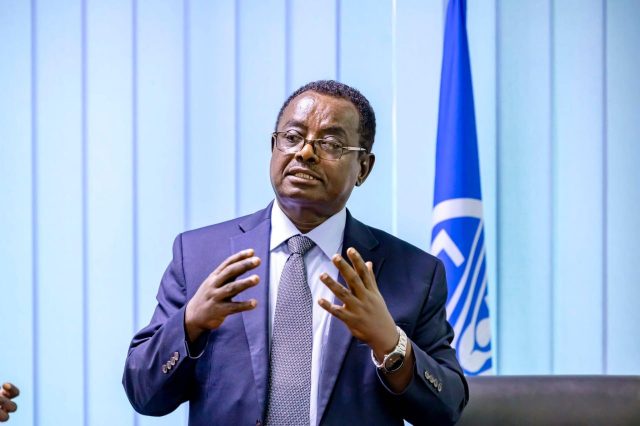
EBR INTERVIEW | FAO’S AFRICA CHIEF
By Betegbar Yaregal | Interviewed on 27 October 2026, Addis Ababa
FAO’s Africa chief Abebe Haile-Gabriel (PhD), who helped roll out the continent’s agriculture programme at the African Union, tells EBR that technology exists, but processing, predictable policy and long-term investment do not.
Two months into his job as head of Mozambique’s national agricultural research, the official stood up at a forum in Addis Ababa and told delegates he had no budget at all. “The government gives you the title, but doesn’t give you five cents,” Abebe Haile-Gabriel (PhD) recalled in an interview with EBR. Ethiopia, he said, is an exception on a continent where many research systems now exist “only in name”.
The same shortage of follow-through, Abebe argues, sits behind Africa’s food import bill, which he puts at more than $90 billion a year. Other estimates are lower, but his point is the same: even if half of that money were redirected into raising productivity, he said, “a lot of jobs and opportunities would be created”. The obstacles, in his telling, are practical: crops that spoil for lack of processing, imported poultry feed, policies investors cannot predict, and pledges that never turn into budgets.
Abebe, an Ethiopian, began his career teaching at Haremaya University in 1986 and joined the African Union Commission in 2005. As director of its rural economy and agriculture department until 2015, his work, according to his published biography, included rolling out the Comprehensive Africa Agriculture Development Programme (CAADP) and preparing the 2014 Malabo Declaration.
He joined the Food and Agriculture Organization of the United Nations (FAO) that year and has been its Assistant Director-General and Regional Representative for Africa since 2019, overseeing programmes in 47 countries.
He spoke to EBR on the sidelines of the Africa Science and Innovation Forum, as the continent begins implementing the Kampala Declaration of January 2025. The conversation has been edited for length and clarity.
EBR: The fifth CAADP Biennial Review says overall performance has improved, but none of the 45 countries that reported met the Malabo benchmark. How did we get here?
Abebe: CAADP is the Comprehensive Africa Agriculture Development Programme. Despite the “P” in its name, it is really a continental framework. Countries use it as a common umbrella, then develop their own strategies and investment plans.
It began in Maputo with a simple logic: without modernising agriculture, there is no growth and no jobs, because most Africans live in rural areas. Two targets were set. Agriculture should grow by an average of 6 per cent a year, a figure backed by studies that FAO helped to carry out.
And governments should put at least 10 per cent of their annual budgets into agriculture. That second target matters because it proves ownership. It says this agenda is ours, and our partners can help after that.
Ten years later, only a few countries had met them. At Malabo in 2014, leaders settled on five or six clear targets and added a review every two years. They also agreed that leaders of well-performing countries should be recognised with awards.
The idea was healthy rivalry: if one leader watches another collect a trophy, he will ask his minister why his own country is not performing. About 45 countries submitted data. Not one met every target. Rwanda and Morocco have been consistently good.
EBR: Twenty-three years after CAADP was adopted, many say little has reached the farmer. Why?
Abebe: Technology exists, and it is not necessarily unaffordable. The problem is connecting solutions with the people who need them, like matching a job with a job seeker. Africa has fallen very far behind on that.
Countries such as Vietnam and China used data and technology to lift productivity, and not by chance. They had clear strategies, government investment, and farmers who understood the value, received support and sustained it over the long term.
FAO also facilitates South-South and Triangular Cooperation, bringing in experience from countries that modernised their agriculture in 30 to 40 years. The technology is adapted and results appear. But the results often last only as long as the project. When the project ends, things revert to where they were. That is one reason for this forum: how do we scale what works at pilot level so that it benefits many more people?
EBR: Where are the biggest gaps along the value chain?
Abebe: Take production first, then the market. Suppose a farmer is told to grow avocados or tomatoes. They buy the technology and the fertiliser and spend a lot of money. If they cannot reach a market, or there is no industry to process the crop, it spoils.
Post-harvest loss is extremely high. There is no capacity to turn fruit into juice, to package it so that it lasts, or to move it over long distances. Bananas left by the roadside for three or four days are gone. Cold-chain technology exists. It is not that the solutions are missing.
Poultry is a good example. A great deal of chicken meat in Africa is imported, paid for in hard currency, from places such as Brazil, because city restaurants need consistent quantity and quality that village chickens cannot supply.
But we can produce that here, and Africa’s agro-ecology is, if anything, even better suited to farming. So why do we spend billions every year importing chicken and rice? The countries we buy from may have only 5 to 10 per cent of their people in agriculture, but those farmers are backed by machinery, technology and supportive policies.
EBR: Is investment mainly the government’s responsibility?
Abebe: If you do not invest, nothing happens. Science and innovation are not free, even when they are generated at home.
Take poultry again. A panel at the forum heard that feed accounts for about 70 per cent of production costs. If feed is 70 Birr of a 100-Birr chicken, a hypothetical figure, then to be competitive you must find cheaper feed. Yet we import it. Feed is not complicated: maize, fish meal. The know-how exists. What it needs is investment, and that should come from the private sector.
Individual farmers may find it difficult, but they can organise as cooperatives or joint-stock companies. Banks are joint-stock companies. Why can’t agro-industries be, with farmers as shareholders and professional managers?
But investors need conditions. If policy is unpredictable, nobody will put money in. If the government changes its policy after six months, I lose. So the government must create the enabling environment: predictable policy, roads, electricity. Look at Addis Ababa. When a big new road opens, buildings spring up along it. The private sector builds them, but the government provided the infrastructure. Agriculture is no different.
“What matters is not just what is pledged on paper each year, but how much is actually mobilized and whether real change comes from it.”
EBR: What is FAO doing in Ethiopia?
Abebe: FAO does not impose its own priorities. The government sets out what it wants in agriculture and food for the next several years, and we agree a Country Programme Framework around the areas where we have an advantage. We are not the African Development Bank or the World Bank; we do not bring sacks of money. We bring technical expertise, a global network and experience from other countries. That could be animal health, agro-industry or preparing for drought.
Desert locust control is one success. Around the time of COVID there was a massive invasion across East Africa. Pests have patterns, so you can forecast when they hatch, how the wind moves them and where they will land. We built forecasting capacity with countries, including Ethiopia, and mobilised international funding for control operations.
We also run the Hand-in-Hand Initiative, an investment platform. A country chooses its priorities, whether coffee, wheat or fruit, and we help it develop investment proposals and invite investors to Rome, as we did two weeks ago. Investors ask hard questions about what is in it for them, so countries must come prepared. I think Bangladesh did best, mobilising around $90 million from the World Bank. But a country’s problems are created by the country itself. External organisations assist; the primary work must be done by the country.
EBR: What share of its budget should Ethiopia put into agricultural research?
Abebe: I do not want to guess a number without looking at the data. But compared with the rest of Africa, Ethiopia is a leader in agricultural research investment. In many countries the research systems now exist only in name.
The cause was structural adjustment. The IMF and the World Bank told governments to cut public spending, for example by commercialising extension services so that farmers paid private providers. Research institutions came to depend on donors, who have their own agendas. If your proposal does not match the donor’s interest, you do not get funded, and national priorities fall by the wayside.
What makes Ethiopia unusual, from my oversight of 47 countries, is that the Ethiopian Institute of Agricultural Research still has its staff salaries and operations paid from the government budget, with money allocated for research. It also raises external funds. Is it enough? No. But the government believes in it and funds it, and that should be recognised.
Elsewhere the picture is worse. We heard it at this forum from the head of Mozambique’s national research system, who has a title and no funds. Sometimes we talk at a high level, but down there even the most basic things are missing.
EBR: The Kampala Declaration targets $100 billion in public and private investment by 2035, and Rome saw a record $20.16 billion in proposed investments two weeks ago. Is the target realistic?
Abebe: It is a target; that is how much we aim to mobilise. But it is not the most significant issue. What matters is how much is actually mobilised, and whether real change comes from it.
Kampala was adopted in January 2025. When January comes, it will be two years. When you ask what has been done on the ground, I see very little. That is the big gap. Since 2003, politicians have talked, but people’s livelihoods have not improved and productivity remains where it was. That is why we have become food-aid recipients with a food deficit, importing over $90 billion worth of food a year. Others quote lower figures, but that is the minimum, depending on the source.
We borrow to pay for this, and consumers pay out of their own pockets. If even half of it were diverted into raising productivity, a great many jobs and opportunities would be created. But that takes leadership. Morocco and Rwanda did not succeed by accident. The government rolled up its sleeves and holds everyone accountable. Without real leadership, change will not happen.
His message to the forum’s opening session was that Africa does not need another declaration of the importance of transformation. The outcome document and roadmap are due on Thursday. In his opening speech, Abebe proposed that they include a first implementation stocktake within two years, linked to existing national and CAADP review processes, so that commitments are checked against results.
BY THE NUMBERS
- 45 of 55: African Union member states that reported to the fifth CAADP Biennial Review; none met the Malabo targets, though 35 scored better than in the previous review (African Union).
- $100 billion: Kampala Declaration target for public and private agrifood investment by 2035, alongside at least 10 per cent of public spending and 15 per cent reinvestment of agrifood GDP (African Union, January 2025).
- $20.16 billion: proposed investments at FAO’s Hand-in-Hand Investment Forum in Rome , 13 October 2026 (FAO).
- Over $90 billion: Africa’s annual food import bill, by Abebe’s estimate. The UN Economic Commission for Africa’s Hanan Morsy cited $70–100 billion at the forum.
- About 8 per cent: Africa’s share of global public agricultural research spending (FAO Director-General Qu Dongyu, video message to the forum).
 Eden Teshome
 Dr. Brook Genene