By Betegbar Yaregal December 19, 2025

FC Africa has brokered Ethiopia’s first blended finance partnership specifically designed for conflict-affected regions, initiating a pilot project to provide uncollateralized loans to micro, small, and medium enterprises (MSMEs) in Mekelle and Abala. The agreement involves Lion International Bank, which will disburse the loans through its digital platform, Alegnta.

blended finance which is a strategic model that uses public or philanthropic funds to de-risk investments, making projects in challenging sectors more attractive to private capital. In this case, it enables a private bank to lend to high-risk, underserved businesses it would typically avoid.

The initiative aims to overcome the severe credit constraints faced by businesses whose operations were disrupted by conflict, lack of traditional collateral, or weak credit histories. It specifically targets enterprises run by returnees, internally displaced persons (IDPs), and host community members, with the goal of restoring livelihoods and stimulating local economic recovery.

The pilot is being implemented under the five-year ER-CAP Programme (Economic Recovery in Conflict-Affected Areas Programme). This programme is funded by the Government of Sweden and led by Mercy Corps in partnership with the Danish Refugee Council and FC Africa.

The ER-CAP Programme focuses on restoring livelihoods in conflict-affected areas such as Tigray, Afar, and Amhara by supporting the businesses of IDPs, returnees, and host communities.

The blended finance structure combines private capital from Lion Bank with public concessional funds, which act as a de-risking mechanism to encourage lending in high-risk areas. The model is supplemented by technical assistance to strengthen enterprise readiness and build the bank’s confidence in these underserved markets.

FC Africa, a leading economic development consulting firm formerly known as First Consult, designed the partnership.


By Betegbar Yaregal– December 19, 2025

US President Donald Trump has indefinitely suspended the Diversity Visa Lottery program, a key immigration pathway used by about 50,000 people annually. The move came after the suspect in two university killings was found to have entered the United States through the program.

According to a report by the *Daily Mail*, Homeland Security Secretary Kristi Noem announced the suspension in a social media post, stating, “At President Trump’s direction, I am immediately directing USCIS to pause the DV1 program to ensure no more Americans are harmed by this disastrous program.” She linked the decision directly to the perpetrator of the recent violence, a Portuguese national named Claudio Neves Valente.

The suspension follows two separate attacks. On December 13, a shooting at Brown University in Rhode Island left two students dead and nine injured. Two days later, Massachusetts Institute of Technology (MIT) physics professor Nuno Loureiro was killed at his home in Brookline. Police identified Neves Valente as the prime suspect in both cases. Authorities confirmed that the suspect, who was found dead from a self-inflicted gunshot wound in New Hampshire on December 19, had won a Green Card in the 2025 Diversity Visa Lottery.

The program, established by the US Congress in 1990, randomly selects applicants from countries with historically low US immigration rates. The *Daily Mail* For the 2025 lottery, which saw nearly 20 million global applicants, only 38 slots were allocated to Portuguese citizens. The move aligns with the Trump administration’s broader stance on stringent immigration controls and is expected to face legal challenges.

According to U.S. government data , hundreds of thousands of Ethiopians apply for the program annually, with over 1 million total entries from Ethiopia recorded in recent years. The program has been a pathway for the Ethiopian diaspora, which numbers an estimated 350,000 to over 460,000 people in the U.S.

This suspension follows another recent U.S. immigration decision affecting Ethiopians. On December 14, the Department of Homeland Security terminated Ethiopia’s Temporary Protected Status (TPS), declaring conditions in the country “no longer pose a serious threat.” The dual moves significantly narrow legal immigration avenues from Ethiopia to the United States.


By Betegbar Yaregal– December 19, 2025

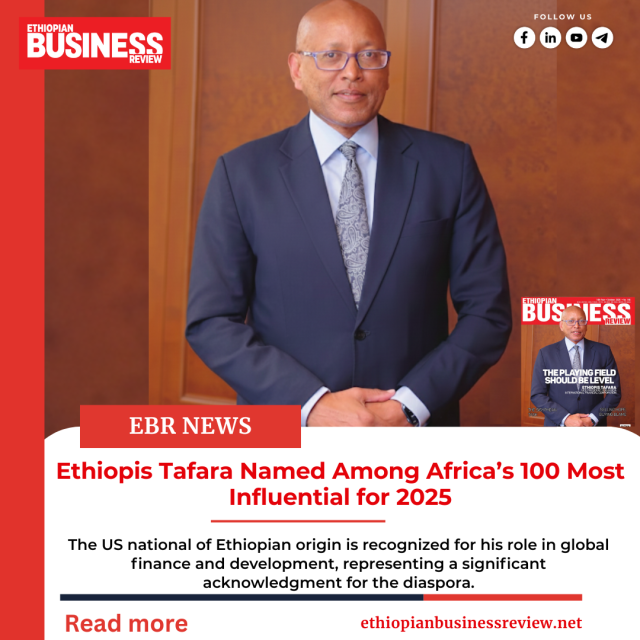
Ethiopis Tafara, IFC’s regional Vice President for Africa, has been named to New African magazine’s prestigious ‘100 Most Influential Africans’ list for 2025.

The US national of Ethiopian origin is recognized for his role in global finance and development, representing a significant acknowledgment for the diaspora.

This year’s compilation features 21 individuals in the Business and Finance category, making it the largest segment.

The list includes both established figures and influential newcomers such as George Elombi, the newly appointed President of Afreximbank, and Hazem Ben-Gacem, the Tunisian investor known for scaling global ventures.

Technology also features strongly, with eight entries focused on pioneers developing African-centric artificial intelligence solutions, emphasizing local ownership and problem-solving.

In a recent interview with EBR, Ethiopis reflected on the changes in Addis Ababa. He shared, “My earliest memory of the city is walking home from St. Joseph School. My experiences from ages 11 to 16 are particularly vivid, as I witnessed dramatic city changes.

”Even compared to my 2021 visit, the development today shows significant and ongoing progress. It gives a very positive image of the country”, he added

Born in Ethiopia and raised in Ethiopia and Italy, Tafara holds a JD from Georgetown University Law Center and an AB from Princeton University.

He is fluent in Amharic, French, Italian, Spanish, and English. His work at the IFC, the private sector arm of the World Bank, involves financing critical development projects across Africa, with significant engagement in Ethiopia’s economic landscape.

In total, the list represents 32 African nations, featuring 64 men and 36 women. Nigeria leads with 21 entries, followed by South Africa with 10, and Kenya and Ghana with seven each.

According to New African Editor Anver Versi, the list reflects a trend of Africans “reclaiming the African narrative” across fields from AI ethics to the arts during a time of global uncertainty.


The SNV-led Livelihoods Improvement for Women and Youth (LIWAY) project has disbursed more than 180 million birr in loans through alternative financing models, supporting over 4,000 micro and small enterprises (MSEs) across Ethiopia.

The update was shared during an access-to-finance learning symposium held on December 17, 2025, at the Hyatt Regency Addis Ababa under the theme “Unlocking Finance for MSMEs.” The event brought together banks, microfinance institutions, fintech companies, and government agencies to discuss persistent financing gaps facing small businesses.

Organized by SNV and Mercy Corps, the forum focused on practical solutions to address collateral constraints and credit access barriers that continue to limit the growth of micro, small, and medium enterprises.

Speaking at the symposium, LIWAY Team Lead Yewubdar Hailu said the project has so far reached more than 300,000 people, with youth accounting for 75 percent of beneficiaries and women representing half of participants. The project aims to reach 400,000 people by December 2028.

“So far, we have tested five different financing models with our partners,” Yewubdar said. “Cash-flow-based lending blended with insurance has onboarded more than 4,000 micro and small enterprises into the formal financial system.”

LIWAY is funded by the governments of Sweden and the Kingdom of the Netherlands and focuses on improving livelihoods by expanding access to finance, markets, and skills development for youth and women.

Julie Graham, Country Director of SNV Ethiopia, said access to finance should go beyond credit provision alone.

“Increasing access to finance is not just about loans,” Julie said. “It requires a holistic system that includes savings, microinsurance, and responsible lending, supported by collaboration among regulators, financial institutions, civil society, and the private sector.”

Discussions at the symposium also highlighted future policy priorities. SNV is working with private sector partners to develop national lending standards for cash-flow-based loans, establish interoperable data-sharing systems for MSME credit histories, and design gender-responsive financial products tailored to women entrepreneurs.

SNV, which has operated in Ethiopia for over 50 years, said it is now focused on scaling pilot initiatives into broader policy frameworks. In collaboration with the National Bank of Ethiopia and private financial institutions, the organization aims to institutionalize alternative lending practices that reduce reliance on traditional collateral requirements.


IFC-1-0001_1.jpg

VisionFund Microfinance Institution S.C., established in 1998, is the largest microfinance Institution in Ethiopia. It currently serves over 1.9 million clients across the country in both rural and urban areas. With a robust network of 121 branches and expanding digitally enabled operations, VisionFund MFI is providing convenient and easily accessible financial services. VisionFund’s core mission is to promote savings, support entrepreneurship, and enhance the livelihoods of low-income and underserved populations throughout the country.


IMG-20251105-WA0000.jpg

Dashen Bank is excited to announce the official launch of the Dashen Edil, an innovative digital reward and gamification experience available exclusively on the Dashen Super App. With a total prize pool of up to 30 million birr, this campaign offers Dashen Super App customers a unique opportunity to win exciting rewards while engaging with the Bank’s cutting-edge digital services.

The Dashen Edil Lottery introduces a more dynamic and rewarding way for customers to participate and win. Through everyday digital transactions, users can easily earn “coins” within the Dashen Super App by: Making money transfers, downloading and activating the Super App, receiving funds from other banks, making merchant payments and bill settlements, using the airtime top-up feature, engaging in chat banking and budgeting tools, and other features of the Super App.

Customers can then use their collected coins to “shake” their phones and instantly win prizes ranging from mobile data packages and e-money rewards of Br. 100 to Br. 100,000, to premium smartphones including Samsung Galaxy S23, Galaxy A54, and iPhone 16 models, as well as a brand-new BYD car.

Starting November 1, 2025, Dashen Bank will begin awarding thousands of prizes throughout the Dashen Edil campaign period. This initiative is designed not only to reward Dashen’s loyal customers but also to inspire greater use of the diverse features offered by the Dashen Super App.

Join the excitement today!

Download the Dashen Super App, start earning coins, and take your chance to win life-changing prizes while experiencing the future of digital banking with Dashen Bank.

https://www.dashensuperapp.com/download


photo_2025-07-12_21-49-11.jpg

Nib International Bank has officially launched its new mobile super app, “Nib Tera Online”, as part of its ongoing digital transformation agenda. The platform, 95% developed in-house, went live July 12, offering customers a more streamlined and user-friendly banking experience.

The launch of Nib Tera Online is a key component of the Bank’s newly unveiled three-year strategic plan and five-year transformation roadmap, which emphasize service innovation and customer-focused digital expansion.

During the official launch event, CEO Henok Kebede highlighted the Bank’s commitment to modernizing its service delivery. “Nib International Bank is deeply invested in understanding and addressing customer needs. Through this application and our broader strategy, we aim to deliver efficient, tech-driven financial services,” he stated.

The Nib Tera Online app enables customers to easily manage transactions, make payments, and access various banking services directly from their mobile phones. It also includes robust security features and has been internally developed by the bank’s in-house IT team.
In addition to retail banking features, the application supports improved financial management for businesses. It facilitates smoother interbank transfers, budget control, and a range of operational banking tasks. The bank noted that more digital services will be integrated into the platform in future updates, with the goal of enhancing efficiency and delivering measurable results.

As part of its transformation agenda, Nib International Bank plans to continue leveraging emerging technologies to improve customer experience and drive institutional growth.


White-Minimalist-Economics-Headline-News-Instagram-Post-2025-07-11T134757.174.png

Africa is emerging as a powerhouse in the global coffee trade reaching to 33.3% in May, with Uganda and Ethiopia leading a remarkable surge in exports that is reshaping the continent’s role in the world market.

According to the latest International Coffee Organization (ICO) report, global coffee exports rose 4.9% from May 2024 to 12.65 million bags, boosted largely by African producers. Uganda’s exports jumped 43.3% to nearly 800,000 bags, while Ethiopia’s rose 42% to about 980,000 bags. Together, the two countries accounted for more than 75% of Africa’s coffee shipments last month. 

Uganda surpassed Ethiopia as Africa’s top coffee exporter in May, shipping 47,606 metric tons compared to Ethiopia’s 43,481 tons. The surge earned Uganda USD243.9 million for the month, contributing to an annual export revenue of USD2.09 billion. However, the report noted that Ethiopia’s coffee production is currently in an “on” year of its two-year cycle, leading to an estimated increase of 500,000 bags.

Global coffee exports for the year to date fell to 91.29 million bags, a decrease from 93.44 million.

Three of the four major coffee-exporting regions posted growth in May, with Asia and Oceania leading the surge. The region exported 4.11 million bags, up 48.9% from 2.76 million a year earlier.

The ICO report also noted a 46.8% increase in roasted coffee exports in May, highlighting growing value addition within the sector.


White-Minimalist-Economics-Headline-News-Instagram-Post-2025-07-11T112727.091.png

The Addis Ababa City Administration said it has completed 15,960 development projects across the capital in the current Ethiopian fiscal year.

Mayor Adanech Abiebie reported this during the annual performance review at the 4th regular session of the City Council. She said a total of 5,563 retail shops and 1,064 workshop sheds have been built in major commercial areas including Kazanchis, Bole, Lideta, Lafto and Arat Kilo, in partnership with public and private actors.

The mayor also noted that 8,786 homes were built or renovated by volunteers, while another 5,176 were constructed through municipal funding.

Addressing the city’s transportation needs, the report revealed the completion of 153 parking facilities and terminals, as well as significant road infrastructure improvements. Over 1,392 kilometers of asphalt, cobblestone, gravel roads, and sidewalks were constructed or maintained to ease congestion and improve connectivity.

The Mayor emphasized that 9,000 of the completed projects were achieved through community participation and volunteerism, underscoring a model of collaborative development that could inspire similar efforts nationwide. Of the total projects, 16 were categorized as mega projects, reflecting substantial investment in strategic infrastructure.

Source: Ethiopian News Agency (ENA)


White-Minimalist-Economics-Headline-News-Instagram-Post-2025-07-11T105033.434.png

The African Union has called on member states to accelerate the ratification and implementation of key legal frameworks necessary to operationalize the African Continental Free Trade Area (AfCFTA) as its 47th Ordinary Session of the Executive Council opened yesterday in Malabo.

The meeting, held under the theme “Justice for Africans and People of African Descent Through Reparations,”  brings together foreign ministers and senior officials to deliberate on critical priorities, including the Union’s 2026 budget.

In his opening remarks, newly elected AU Commission Chairperson Mahamoud Ali Yusuf acknowledged progress in mobilizing domestic resources but warned that the Union continues to face serious financial constraints.

He pointed out that the landmark 2016 Kigali decision which introduced a 0.2% levy on selected imports to fund the AU has yet to be fully implemented. To date, only 17 member states have adopted the measure.

Ethiopia has recently finalized its National AfCFTA Implementation Strategy, which outlines the country’s roadmap for integrating into the continent-wide free trade pact. Currently, 36 African countries and three regional economic communities (RECs) have developed and launched their National AfCFTA Implementation Strategies.

African countries are advancing on several fronts to reduce dependence on aid and external markets. Sources reveal that nearly half of African countries have restricted exports of raw critical minerals, pushing instead toward domestic processing.

The Chairperson also highlighted the persistent challenges undermining Africa’s development agenda, including political instability, humanitarian crises, and security threats in Sudan, the Democratic Republic of the Congo, Somalia, and the Sahel region. He noted that funding shortfalls continue to hamper the African Union Support and Stabilization Mission (AUSOM), which plays a vital role in peacekeeping efforts.

Nevertheless, Yusuf pointed to recent positive developments, such as the agreement between the Democratic Republic of the Congo and Rwanda, Gabon’s return to constitutional order, and Guinea’s transitional plan, as encouraging signs of progress.

Looking ahead, the Chairperson called on member states to strengthen collaboration with regional economic communities, the Peace and Security Council, and the UN Security Council to consolidate peace and economic integration.

The Executive Council session will continue until July 13, 2025. Additionally, on July 14, the AU will convene its 7th Mid-Year Coordination Meeting with key stakeholders to further align continental priorities and strategies.


Source: Ethiopian News Agency (ENA)


Ethiopian Business Review | EBR is a first-class and high-quality monthly business magazine offering enlightenment to readers and a platform for partners.


2Q69+2MM, Jomo Kenyatta St, Addis Ababa

Tsehay Messay Building

Contact Us

+251 961 41 41 41