quarantin-empty-cafe-exhibition-complex-hall-due-to-epidemic-covid-176583410.jpg

Ethiopia has lost over USD300 million from Meeting Incentives Conferencing and Exhibitions (MICE), since the corona virus, according to a study presented by Addis Ababa chamber commerce and sectoral association, on December 31 There were 24 international exhibitions organized in Addis Ababa, annually, before covid19. There are
also over 700 event organizers in Addis Ababa, who currently has lost their manpower. Between ETB200 million and ETB250 million transactions takes place per exhibition, according to Aklile Belete, managing partner at African Trade Fairs Partner.

The-Cost-of-Conflict.jpg

Since 2015, anti-government protests, conflict, and instability have been ravaging Ethiopia. Especially in the past two years, the breakdown of law and order has become the new normal. Thousands have lost their lives and in 2018, 2.3 million were internally displaced—a world record high. In fact, in the last two and a half years, excluding the latest operation in Tigrai, 113 conflicts have erupted across the country. As a result, the federal government’s expenditure to secure public order and security swelled from ETB14.2 billion in 2017/18 to a staggering ETB24.2 billion in 2019/20. Though without a known updated figure, the latest operation in Tigrai is sure to compound Ethiopia’s security bill. EBR’s Ashenafi Endale explores the direct and indirect costs of conflict and instability, as well as the overall economic losses.


The-Loan-Is-Denied.jpg

Despite Excess Liquidity, Banks are Disbursing Less Credit

Following the replacement of currency notes, the banking industry’s liquidity level grew six-fold compared to the previous year. Close to ETB45 billion of fresh savings entered the banking system, while 2.5 million new saving accounts were opened. Despite surplus liquidity, commercial banks are not disbursing credit as per their capacity. Some attribute this to the political violence and instability in Ethiopia in the past five years, which has diminished the appetite of credit seekers. Others claim banks are currently holding back from giving loans because economic and business activities are slowing down and default rates are increasing. EBR’s Ashenafi Endale explores.


EthSwitch-Logo-Ethiopia-ET-Switch-1280x720-1.jpg

Eth-Switch S.C, Ethiopia’s national payments switch, declared ETB94.5 million revenue and ETB24.3 million net profit for 2019/20 Ethiopian financial year. Its profit surged by 93pct from previous year, following increasing use of electronic transaction under covid19 pandemic and government measurements to discourage cash-based transactions. Eth-Switch has been reporting loss for three consecutive years until last year.


eyob-ministry-of-trasher.jpg

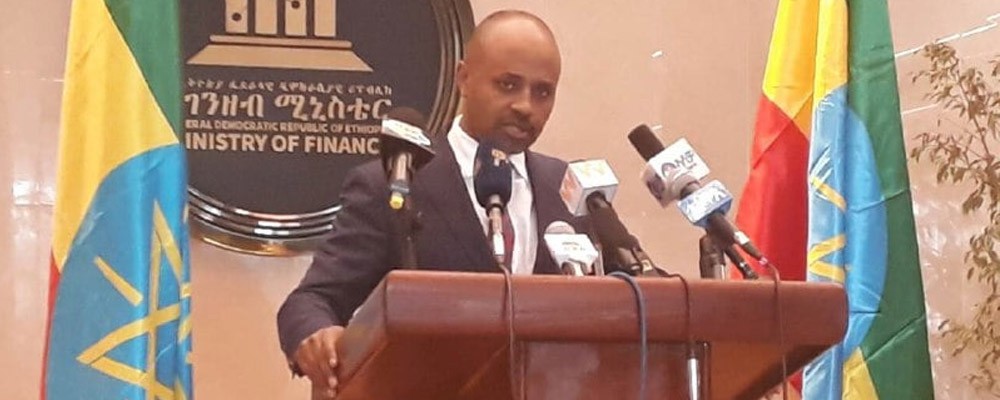
The Ethiopian Telecommunication Authority has floated Request for Proposals that leads to pick two private telecom service providers. The bidding will be open for the next three months, after which the winners are licensed by April 2021, according to Eyob Tekalign (PhD), state minister of Finance.


Supply-Distortion-The-Law_1.jpg

As a developing country, the Ethiopian economy is largely characterized by the informal sector with studies indicating its expanding size. The International Monetary Fund estimates that in countries in transition, like Ethiopia, the underground economy accounts for as high as 40.1Pct of GDP. Although the government has been taking different measures to reduce the role of the informal sector, these interventions have failed to materialize. However, the government now says its latest measure of replacing currency notes with new ones is positively working in that direction. But experts disagree with the government’s concision by saying the expansion of the informal economy is highly interconnected with the formal economy’s failure to produce enough goods to satisfy national demand. EBR’s Ashenafi Endale reports.


Amelework-Gidey.jpg

“I Want to be the Top Industrialist Woman in Africa.”

Amelework Gidey is Founder and Managing Director of Technostyle, a company known for over 20 years as a furniture importer and distributer. She is one of the leading female entrepreneurs in Ethiopia’s emerging manufacturing sector. With the acquisition of the foam and furniture manufacturing division of MNS, a Turkish based textile manufacturer and exporter, Technostyle has been expanding through backward integration of its core businesses since 2015. This has given the company a better competitive edge as it now controls a good proportion of the supply of raw materials.


Pushing-or-Pulling_1.jpg

The Role of Public Enterprises in Ethiopia

Ethiopia’s economic policies of the past two decades indicate the growing role and significance of state-owned enterprises (SOEs). Essential services such as electricity, telecommunications, shipping and logistics, and transport are mainly provided by SOEs. In addition to giant public enterprises, like Ethiopian Airlines, Ethio Telecom, and Ethiopian Electric Power, there are also SOEs engaged in railways, industrial parks, hotels, sugar, and other manufacturing industries. Although SOEs are increasing in the volume of transactions they involve, most remain inefficient and unable to service their debts. Their accumulated debt is especially skyrocketing, putting a huge stress on the national economy. The current accumulated debt of 21 SOEs is ETB846 billion, which is more than half of the total national debts. EBR editors explore the issue.


Beyene-Hailemeskel.jpg

Beyene Hailemeskel, is the former Director General of the Public Enterprises Holding and Administration Agency (PEHAA), which oversees 21 state-owned enterprises (SOEs) in Ethiopia. He joined the agency 20 years ago, gradually climbing the ladder to the top position. Beyene, who argues that state intervention remains a crucial driver of Ethiopia’s economy, stresses SOEs are undergoing deep reforms to the core. EBR paid audience to Beyene’s reflections on SOEs’ performance and futurity, weeks before he tendered his resignation at the end of October 2020.


Ethiopian Business Review | EBR is a first-class and high-quality monthly business magazine offering enlightenment to readers and a platform for partners.


2Q69+2MM, Jomo Kenyatta St, Addis Ababa

Tsehay Messay Building

Contact Us

+251 961 41 41 41