

Birhanu-Gizaw.jpg

Currently, Ethiopia is striving to construct 30 industrial parks in the next two years, as shortcut to cope with late industrialization. However, Birhanu Gizaw (PhD), who has been an industrial engineer both in the academic and private sector for 30 years, the last 15 of which he has spent in Germany, boldly argues that Ethiopia needs to revise its industrialization policy. He argues industrialization is about a fundamental change in mentality, and manufacturing products and technology that simplify the life of each and every citizen, rural and urban alike. Currently, he is developing a technology park in collaboration with Jimma University, the first of its kind. In addition he is a lecturer at the Addis Ababa institute of Technology, and is chairperson for the Society of Electrical Engineers. He recently sat down with EBR’s Ashenafi Endale to discuss the country’s industrial efforts. The following is an excerpt:


Bonus.jpg

Incentive, Burden

Globally, various bonus schemes are used to keep employees satisfied and motivated. This strategy is increasingly seen adopted by banks, insurances and corporations in Ethiopia. It is becoming common to witness banks and insurance companies showering two to four months of salaries on employees as bonuses. Although these companies are benefiting from the strategy, there are still concerns, as EBR’s Ashenafi Endale writes.


Acidic-Soils.jpg

A Daunting Task waiting Ethiopia

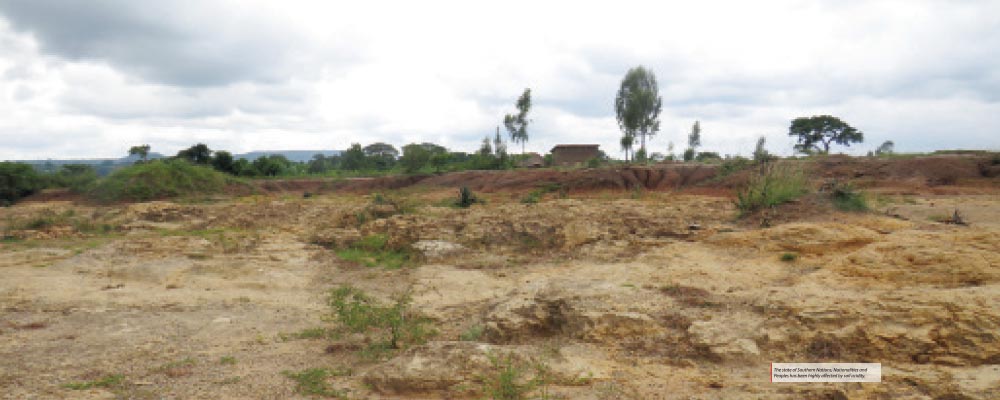
It has been over a decade since the government discovered that a little more than 40Pct of the total arable land of Ethiopia is affected by soil acidity. As a result, the fertility of most Ethiopian soil has already declined posing another challenge to crop production. Soil acidity affects crop growth because acidic soil contains toxic levels of aluminum and manganese and characterized by deficiency of essential plant nutrients such potassium, calcium and magnesium, among others. Had acidic soils been neutralized the country would have increased the production of crops such as cereals four folds. Yet this does not seem like it will be realized soon. EBR’s Ashenafi Endale reports.


Tegbaru.jpg

Tegbaru Belete Program Leader of the Ethiopia Soil Information System

Soil acidity has been a big concern in Ethiopia for a long time. Although the problem has been known for over a decade, the level of action taken by the government was minimal. To avert this problem and develop policy to help farmers improve their yield, the Ethiopian Soil Information System (Ethio SIS) was launched by the Agricultural Transformation Agency in 2012, to bolster the growth and transformation of Ethiopia’s agriculture sector. Tegbaru Belete, program leader of the project, sat down with EBR’s Ashenafi Endale to talk about some of the ins and outs of the project and how the soil acidity problem can be solved.


Brewing-Bitcoin.jpg

Since its creation in 2009, Bitcoin has grown popular across the world. During its earlier years, it was almost monopolized by mega investors. But later on, with the establishment of Bitclub, ordinary people became able to invest in Bitcoin and to own small computing machines on their farm. This includes Hanna Teklie, an Ethiopian entrepreneur and many others who are investing in cryptocurrencies, as EBR’s Ashenafi Endale writes.


Eyob-Tesfaye.jpg

Eyob Tesfaye (PhD), a macroeconomist and policy analyst, is among the few scholars who are known for voicing their concerns about the well-being of Ethiopia’s economy. He has served in different governmental positions, including as the Director-General of the Public Finance Institutions Supervisory Agency and Director of the Academy of Financial Studies at the National Bank of Ethiopia. He has been an external examiner of post graduate students at Addis Ababa University and advisor to post graduate students of the London School of Economics and Georgetown University.


nowhere-to-run.jpg

Eritrean Refugees Left Out in the Cold

Migration is still as a big concern in Eritrea. Youths, frustrated by the policies of the government, cross the border in droves, searching for a better life. Ethiopia hosts the highest number of refugees from Eritrea. The absence of rule of law, unlimited mandatory national service and absence of freedom of expression are reasons usually expressed by refuges for fleeing their home country. Even after entering Ethiopia, most of them are not able to join the workforce, partly because the law does not allow it. While the recent peace between Eritrea and Ethiopia renewed the hopes of a few Eritrean migrants, some still fear that the peace could endanger their lives. EBR’s Ashenfi Endale, reports.


Transacting.jpg

Wide Spread Contraband Trade Cripples Ethiopia

Contraband , part of the shadow economy, is still a threat to Ethiopia’s economy. But even more, it has recently started to affect the well-being of the nation. The recent violence in the states of Ethio-Somali and Benishangul Gumuz shows the severity of the problem. Items from textiles products to precious metals are traded by contrabandists. This has paved a way for a shadow economy to thrive, raising its contribution to the GDP to as high as 40Pct. EBR’s Ashenafi Endale investigates.


Unraveling.jpg

Nation Continues to lose billions to raw material imports

In recent years, domestic sourcing, a procurement strategy adopted by companies to purchase their inputs, is gaining momentum due to the fact that localisation brings cost-savings across the supply chain, especially in light of climbing costs in traditionally low-cost regions. However, although many multinational and local companies are investing in the country, Ethiopia lags behind in this regard. Even though the lack of raw materials on the local market has forced companies to lean towards imports, the scarcity of foreign currency is putting extra pressure on their survival. EBR’s Ashenafi Endale investigates the difficulty faced by manufacturers due to low level of raw materials sourcing from domestic suppliers in Ethiopia.


shewa_dabo.jpg

Why Ethiopia imports huge amounts of wheat while endowed with vast suitable land for farming

In recent years, wheat shortages have been getting more and more severe in urban areas like Addis Ababa, putting pressure on local businesses engaged in wheat processing, as well as residents. On the other hand, close to 10 million people who have been struck by drought and displaced by internal political conflicts have to wait for months in order to receive wheat. EBR’s Ashenafi Endale explores the fundamental reasons behind wheat scarcity in Ethiopia.


Ethiopian Business Review | EBR is a first-class and high-quality monthly business magazine offering enlightenment to readers and a platform for partners.


2Q69+2MM, Jomo Kenyatta St, Addis Ababa

Tsehay Messay Building

Contact Us

+251 961 41 41 41