coca-cola-ceo-ebr_2.jpg

EABSC Gazes at the Sunshine Across from the Discomfort of the Eye of the Storm

Daryl Wilson, CEO of East African Bottling Share Company (EABSC), arrived in Ethiopia just last year. Originally from south Africa, he was Managing Director of Nairobi Bottlers of Kenya for nine years before coming to Ethiopia. With 27 years in the business, Daryl Wilson has seen the troughs and the picks of the industry even before the turn of the century. He is already overseeing construction of two epic factories in Hawassa and Sebeta with an outlay of a staggering USD300 million. The two factories will triple the volume of coke products in Ethiopia, besides launching new products. He says Ethiopia is the fastest growing beverage consumer market in Africa. Nonetheless, the humorous CEO is not all that excited. The company already lost over 15Pct of its sales revenue due to the new Ethiopian excise tax regime and COVID-19. EBR’s Ashenafi Endale spoke to the CEO on various issues.


Corona-Induced.jpg

The world has been in a state of shock since January 2020. Every corner of the globe is struggling to survive the health and economic impacts of the Coronavirus. Ethiopia is already experiencing the brunt of the virus as it reports a fall in economic growth and bankruptcy of several private companies. The most powerful states in the world that were perceived to have economic prowess, developed health system and educated society were apparently not ready for a challenge like the Coronavirus. Supply gaps in essential medical equipment showed their neglect of the most basic products; their health systems were simply overwhelmed by the large amount of cases coming in and their educated population proved to be undisciplined and not so smart after all.


Desert-Locust.jpg

Hunger Hovering By

A swarm of locusts is pushing millions in East Africa to the brink of food insecurity. In Ethiopia alone, over a million people have so far become food insecure and in need of urgent assistance. About 3.5 million quintals of crop has been destroyed by the locust that damaged state and private farms. With predictions the locust attack may increase 400 times in the times ahead, disastrous damages are expected unless preventive measures are taken in time. EBR’s Ashenafi Endale explores.


Mussie-Mindaye.jpg

Mussie Mindaye, Ethiopia’s Top Expert and Negotiator in AfCFTA

Muse Mindaye has been Ethiopia’s top expert and negotiator in the African Continent Free Trade Agreement negotiation forum since the beginning of the effort to create a single African market. He is also director of Multilateral Trade Relation and Negotiation at the Ethiopian Ministry of Trade and Industry. An Economist in profession, Mussie predicts the hour of Africa’s economic redemption against globalization is at the door, only clouded by COVID-19. EBR spoke to him to further understand what Ethiopia would benefit from AfCFTA and how the future will look with the implementation of the agreement.


skyrocketing.jpg

Is it Coming to an End?

It has repeatedly been demonstrated that major international events have the ability to shift paradigms. The post-cold war period identified by the emergence of the United States as the sole super power with other regional hegemons roaming their localities pushed neoliberal policies to the forefront of intra and inter-state relations. With considerable external pressure to adhere to these neoliberal approaches along with the theory’s revamped academic acceptance worldwide, states jumped on board. Accordingly, opening up markets and export promotion became widely accepted approaches. The Coronavirus pandemic has, however, shown that the hectic international trade practices centered on import and export in a highly globalized world have left states, both developed and underdeveloped, a long way from self-sufficiency. EBR’s Ashenafi Endale looks into the impending rise of import substitution in a post-COVID-19 Ethiopia.


Repatriation-the-Destructive.jpg

Gross domestic savings are generally very low in least developed countries such as Ethiopia. That paved the way for foreign investment to emerge as an alternative source of bridging the gap between savings and the required investment after 1992. Since foreign firms bring not only financial capital but also managerial techniques as well as entrepreneurial and technological skills, foreign direct investment (FDI) is regarded as one of the major components of Ethiopia’s economic growth over the past decade. However, it’s not all been rosy. Although initial investment by foreign firms improves the current and capital accounts of the host country, in the long run, repatriation of profit, interest, royalties and management fees may harm its foreign exchange position. This is exactly what is happening in Ethiopia. A minimum of USD1 billion is requested by locally operating foreign companies that repatriate profits annually. However, a fraction of this amount is availed by commercial banks operating in the country. This phenomenon traps foreign companies, forcing them either to wait for a long time to repatriate their profits or reinvest it as EBR’s Ashenafi Endale found out.


left-at-the-mercy.jpg

In the aftermath of free market policies and the subsequent lifting of price caps in Ethiopia, setting the price of commodities seems to be left solely to suppliers and traders. With barely any institutional set ups to protect the rights of consumers, the prices of goods and services has soared in folds with the trend showing no end in sight. The Trade Competition and Consumer Protection Authority established seven years ago seems to be a failure. EBR’s Ashenafi Endale looks into the problems in consumer protection and the road ahead.


searching-for-new.jpg

The major scare on Ethiopia’s international image is its incessant association with famine. Ethiopia has a cycle of drought that recurs every decade. Despite efforts to break the cycle and rise above the embarrassing and life threatening challenge, drought and famine still creep up. Despite decades of experience fighting the vice, Ethiopia still regularly struggles against food self-sufficiency problems. The lingering problem necessitates keeping dependable food reserves. EBR’s Ashenafi Endale investigates the problems behind this chronic problems and sheds light on the road ahead.


The-Need-to-Rise-up.jpg

David Phiri (PhD) is FAO Sub-regional Coordinator for Eastern Africa (SFE) and Representative to the African Union (AU) and to the United Nations Economic Commission for Africa (UNECA). Prior to this post, Phiri was FAO Sub-regional Coordinator for Southern Africa and Representative to Zimbabwe, Swaziland and Botswana. He joined FAO in 1991 as Policy Economist and then served in the Cabinet of the FAO Director‐General. EBR’s Ashenafi Endale sat down with him to understand threats to the food security situation in Ethiopia and the Horn of Africa. Originally from Malawi, David Phiri specialized in Agricultural Economics.


Chocking-the-Life-Out-of-Plastics.jpg

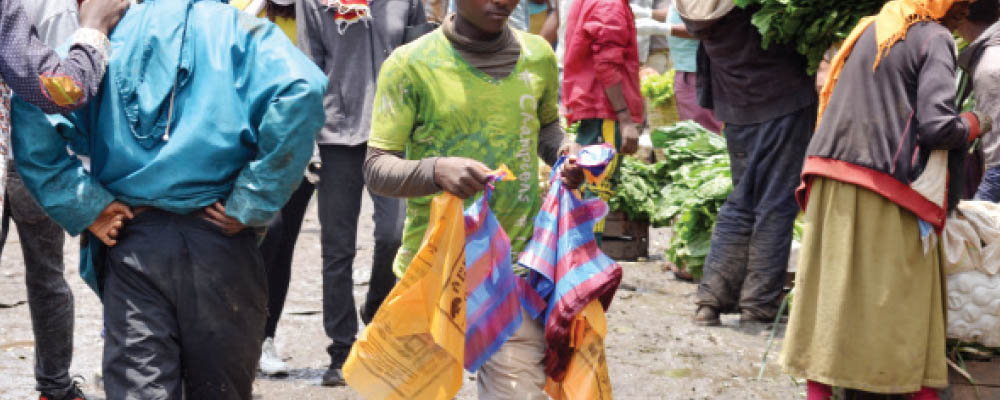
Using plastic bags is a common practice in Ethiopia, a country that aspires to build a carbon free economy by 2025. Although Ethiopia declared producing plastic bags of below 0.03mm illegal long ago, the proclamation has not been put into practice. Retailers openly trade bags below the recommended amount throughout Ethiopia. With that precedent in mind, the government has drafted a new law that totally bans plastic bags. While this is expected to be legislated in the next three months, producers complain such a measure would put them in a precarious situation. EBR’s Ashenafi Endale explores.


Ethiopian Business Review | EBR is a first-class and high-quality monthly business magazine offering enlightenment to readers and a platform for partners.


2Q69+2MM, Jomo Kenyatta St, Addis Ababa

Tsehay Messay Building

Contact Us

+251 961 41 41 41