

Ethiopian Researchers Turn Coffee Waste into High-Purity Cellulose Using Sound Waves
#EBR_News Oct 20, 2026
Researchers at Addis Ababa Science and Technology University have developed a method of converting coffee parchment, a waste product that is largely burned in open fields, into high-purity microfibrillated cellulose, a biomaterial used to reinforce composites, films and coatings.
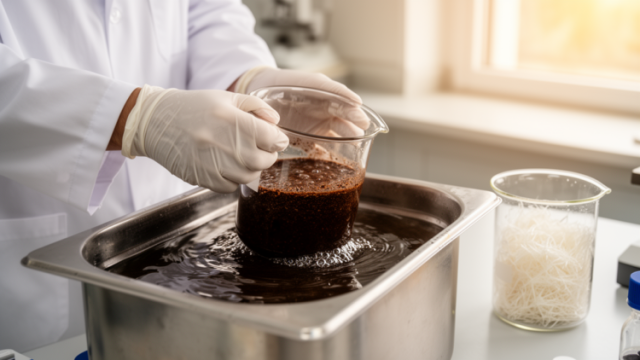
The process combines high-intensity ultrasound with a staged chemical treatment, according to a study published in the journal Case Studies in Chemical and Environmental Engineering.
Coffee parchment is the papery layer removed during drying and hulling, and it makes up roughly 6 to 10 percent of the dry weight of the coffee cherry, the study said. Ethiopia, the birthplace of Arabica coffee and the world’s fifth-largest producer, generates large volumes of it each year.
The authors, Kidanu, Sibhatu and Tizazu, found that the Ethiopian samples contained around 54 percent cellulose by weight, but also a high share of lignin, the tough polymer that binds plant cell walls and resists conventional processing, as reported by Bioengineer.org, which first covered the research.
According to the study, standard treatment with 4 percent sodium hydroxide at 90 degrees Celsius for four hours removed only about 29 percent of the lignin. When the same solution was assisted by 60 minutes of ultrasound, delignification rose to roughly 50 percent and cellulose content increased from 54.3 percent to 71.8 percent, with 96.3 percent of the original cellulose preserved.
The ultrasound works through cavitation, the formation and collapse of microscopic bubbles that break open cell walls and help chemicals penetrate the fibres. Notably, a milder 4 percent alkali dose with ultrasound recovered more cellulose than a stronger 8 percent dose without it, suggesting lower chemical consumption.
The team then applied a two-stage bleaching sequence, using alkaline hydrogen peroxide followed by sodium chlorite buffered at pH 4.5. The report indicates the conventional route reached 72.5 percent overall delignification and a final cellulose content of 83.3 percent.
The ultrasound-assisted route achieved 93 percent delignification and produced microfibrillated cellulose of 91.8 percent purity, cutting residual lignin from 25.5 percent to 3.5 percent.
Laboratory analysis, according to the study, confirmed the quality of the product. Crystallinity, a measure of the material’s ordered structure, rose from 60.4 percent in raw parchment to 80.8 percent, while the purified cellulose resisted thermal decomposition up to 264 degrees Celsius.
The authors said this heat stability matters because the material must survive the high temperatures used when blending fillers into plastics and biopolymers. The ultrasound-derived fibres also dispersed well in water without clumping, a property needed for producing uniform films, coatings and composites.
The authors, however, caution that the process still demands substantial energy and chemical inputs, including repeated bleaching, extensive washing and drying.
They noted that its environmental and economic advantages cannot be confirmed without full life-cycle and techno-economic analysis, and that scaling ultrasound systems from laboratory flasks to industrial operation remains a major engineering challenge.
 Betegbar Yaregal