Hailed-as-‘African-Lion’-with-Fastest.jpg

Michael Buerk’s famished Ethiopia of 1984 has become a nation achieving 93Pct GDP growth in six years, finds study. The television news report by the BBC’s Michael Buerk in 1984 framed Ethiopia for a generation as a place of famine and in need of salvation. Almost 30 years later the country is hailed by pundits as an “African lion” after a decade of stellar economic growth.


Micro-Indeed.jpg

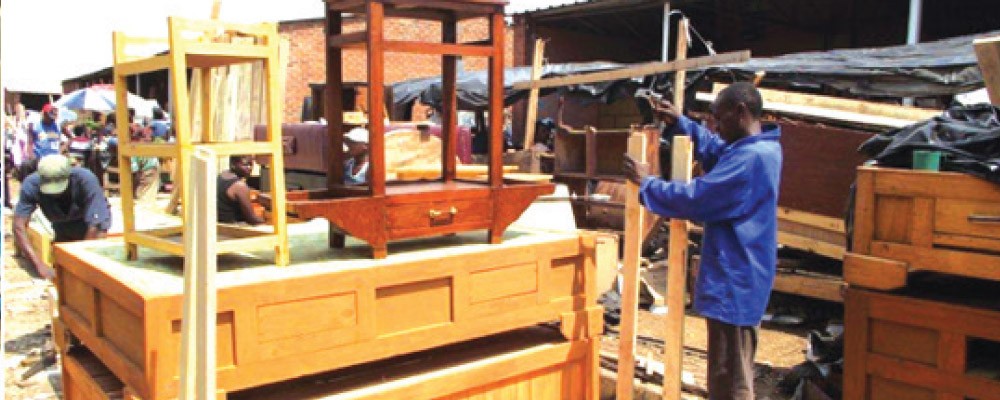
How MSEs are Failing to Support the Manufacturing Sector

When his career hit a bump in the road a decade ago, Dagnachew Bayabill, 36, moved to Bahir Dar for a fresh start, andbrought with him, his ample experience in the shoe manufacturing industry. After settling in the capital of the Amhara regional state, he started making traditional sandals. Business was good due to the availability of cheap raw materials and lack of competition. Years later in 2007, when Dagnachew and his colleagues asked the city administration for a piece of land for their workshop, the administration suggested that they organize themselves as a micro and small enterprise. This resulted in the establishment of Edget Behibret Leather and Leather Products Enterprise, with a total capital of ETB18,000. Currently, the enterprise has more than ETB one million in capital, and employs more than 50 permanent workers; it has graduated to a “transitional level” that will enable it to join the medium manufacturing industry.



Musketeers.jpg

In a recent development, Chinese vendors Huawei and ZTE rolled out a deal valued at USD1.6 billion with the State owned monopoly ethio telecom, deemed as ‘one of the most annoying public enterprises in the country’ by its customers. The telecom has signed vendor finance deals with the suppliers in the last week of July, with Huawei’s share of the deal valued at USD700 million.

The two gigantic Chinese telecom companies make the agreements to expand access to telecom services and add more modern features in to the service, to offer far better telecom services in the country.


Seeing Tadesse Mesfin’s painting – Kelem Kebiw [The Painter] at the age of 16 was a life changing experience for Henok Getachew. Since then, he was immersed in art. Born in 1976, Henok later on went to the Alle School of Fine Arts and Design and graduated with a certificate in General Art in 1997. Since then, Henok has painted dozens of paintings, mainly on the walls of new hotels and restaurants in town and worked for beverage companies as a sign painter. He started doubting his artistic acumen and whether he will be able to live off his promotional paintings when digital art and signage took over the pictorial advertisement business.


ethio_airlines.jpg

Ethiopian Airlines launched its first flight to South America on July 1, 2013. The flight from Addis Ababa to Sao Paulo and Rio de Janeiro, Brazil, the 74th and 75th destinations of the airline, via Lome’, Togo, will increase its flight route network to five continents.

Tewolde Gebremariam CEO of Ethiopian, during the launch, said, “the route will be the only direct [flight] service between West Africa and Brazil and with ASKY, our partner, the airline will connect 22 West African cities with South America.”


The International Labor Organization (ILO) commemorated “World Day Against Child Labor” on June 12, 2013, releasing a new report about the alarming situation many vulnerable children face. The organization urged concerted and joint action at national and international levels to eliminate child domestic labour.

Locally, the day was also observed in Wolayita Sodo in the Southern Nations Nationalities and Peoples Regional State (SNNPR), where many conditions are ripe for children to be exploited through forced labor and trafficking.


The registration process for the new government housing projects has gotten people talking. Starting May 3, 2013 all 115 branches of the Commercial Bank of Ethiopia (CBE) in Addis Abeba were busy with swarms of people hoping to take advantage of the new program. Despite its multi-faceted benefits, not everyone seems to be happy though. Private banks may face further depleted savings as the masses rush to open an account in the Commercial Bank of Ethiopia (CBE); the public financial institution mandated with handling the financial aspect of the project. The 40/60 program that targets the middle class is set to challenge private real estate companies as well.


preginacy.jpg

A new study by the social marketing organization DKT Ethiopia finds that Emergency Contraceptive consumption is on the rise. Commonly known as Post Pills, they are taken in the immediate hours after having unprotected sexual intercourse to prevent unplanned pregnancy. The study indicates that over a five year period between 2007 and 2012 their use increased by 382 Pct. In 2007, there were only 12,432 pills in circulation but this number grew to a record high of 1.58 million in 2012, according to the DKT study. The country spent more than USD29 million to import the pills in 2012 alone.


Ethiopian Chamber of Commerce and Sectoral Association (ECCSA) presented a position paper- Regulation and Openness of Ethiopia’s Service Sectors with an objective of fostering discussion about the private sector’s opinions on Ethiopia’s World Trade Organization (WTO) accession process.

The event, at Hilton Hotel on June 28, 2013, was organized by ECCSA and International Trade Center (ITC). It brought together private businesspeople, officials from ECCSA, including Mulu Solomon, ECCSA’s president and Malcolm Mckinnon, chief executive of ITC and an international negotiator of WTO, who has a decade of experience in the field.


Subsidization.jpg

As June ends and the 2012/13 budget year comes to a close, government offices at the federal and regional levels have been on the rush to reconcile their accounting for this fiscal year and defend their proposals for the next. The 2013/ 14 budget year, from July 1, 2013- June 30, 2014, is set to see a federal budget close to ETB155 billion.

In the Government’s new spending plan, the recurrent budget amounts to around ETB32 billion. The nation’s capital expenditure is proposed to be ETB64 and a half billion while the costs for the Millennium Development Goals will be covered with ETB15 billion. The balance, ETB43 and a half billion is set to be forwarded to regions as unconditional budget grants.


Ethiopian Business Review | EBR is a first-class and high-quality monthly business magazine offering enlightenment to readers and a platform for partners.


2Q69+2MM, Jomo Kenyatta St, Addis Ababa

Tsehay Messay Building

Contact Us

+251 961 41 41 41