Gemechu-Dubiso.jpg

The Man with a Big Job

When the House of Peoples Representatives approved Gemechu Dubiso Godana’s reappointment as Auditor-General of the Office of the Federal Auditor General by Prime Minister Hailemariam Desalegn on March 10, 2015, many agreed that he deserves the post. This is because Gemechu is up to the task based on his five years of experience in the position, demonstrating courage, confidence and uncompromising ethics when he reports about the mismanagement of public resources in federal and regional offices. EBR spoke with Gemechu to learn more about his career and the difficulties facing him and his profession.


Hidden-Messages.jpg

The Trend of Product Placement in the Ethiopian Cinema

Product placement refers to the strategic placement of a particular good, service or location in a film or television show for the purpose of advertising. The phenomenon is common in the American film industry and appears to be taking root in Ethiopia. There’s evidence to suggest that product placement, when done correctly, can prove a fruitful method for a company to advertise its products or services. However, there is also a downside to this advertising method, as it may turn away potential customers from a particular product if done in a haphazard manner. EBR’s Meseret Mamo spoke with filmmakers and advertisers about the growing trend of product placement in Ethiopia.


Gojo’s-Initiative.jpg

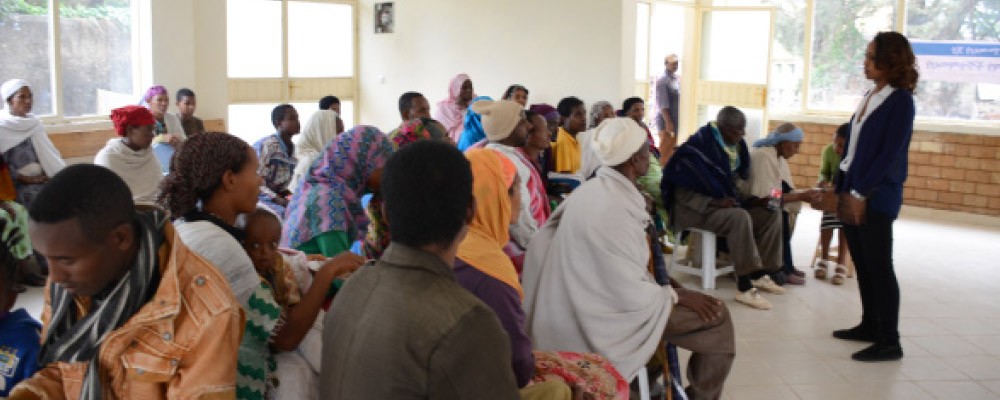
In Ethiopia, it’s not uncommon for patients from rural areas to seek medical treatment in large cities like Addis Ababa, where facilities may be better equipped to handle complex ailments and conditions. These patients, however, are often placed on long wait lists and may have to stay in Addis Ababa for days or weeks at a time. This is especially problematic for indigent patients who may not be able to afford food or shelter while they wait for medical attention. A group of physicians at Tikur Anbessa Hospital, however, are trying to change this reality. They established the Gojo Shelter for the Needy and Sick Community in order to make life easier for patients who face difficulties finding food and shelter as they await treatment. EBR’s Meseret Mamo spoke with the organization’s founders to learn more about how they plan to expand their vision.


Yoga’s-Slow-Growth.jpg

Despite the worldwide popularity of yoga, the ancient craft has yet to catch on in Ethiopia. A few entrepreneurs are trying to change this trend. In Addis Ababa, one can find a few yoga studios and gyms that offer classes. There are even a few centers that offer training to become certified as a yoga instructor. Still, yoga practitioners argue that more work needs to be done before yoga becomes a popular activity. EBR’s Ashenafi Endale spoke with yoga instructors to learn more about the potential of its growth in Ethiopia.


Competitive advantage: creating and sustaining superior performance

Recently the leading role of the agricultural sector to growth in Ethiopia has been challenged by the service and manufacturing sectors. This is partly due to the government’s policy that focuses on the development of the industrial sector, as stipulated in the Growth and Transformation Plan (GTP).


When World War II ended 70 years ago, much of the world – including industrialized Europe, Japan, and other countries that had been occupied – was left geopolitically riven and burdened by heavy sovereign debt, with many major economies in ruins. One might have expected a long period of limited international cooperation, slow growth, high unemployment, and extreme privation, owing to countries’ limited capacity to finance their huge investment needs. But that is not what happened.


Why the 3rd Conference on Financing for Development is critical for the Post-2015 Development Agenda

Addis Ababa, the third largest diplomatic hub in the world, is preparing to host one of the most important conferences of the year: the 3rd International Conference on Financing for Development (also known as the Addis Conference), which will be held from July 13-16, 2015. It is going to be attended by high-level representatives of governments, international and non-governmental organizations and the private sector.


Pottery-Artisans.jpg

The art of creating pottery is a tradition that dates back centuries in Ethiopia. For generations, artisans have used their skills to craft a number of items, including coffee pots, bowls, plates and incense burners, among other goods. Despite the importance of these items in the Ethiopian artistic tradition, the crafting of pottery seems to be a dying trend. The Amatate Chaka Women Potters Association in Kechene, however, is hoping to change that, by providing women a space to create their items and sell them to potential buyers. EBR’s Meseret Mamo visited the Association to learn more about the women who work there and how they’re hoping to keep the tradition alive.


Dangote.jpg

Aliko Dangote, 58, is Africa’s richest man, with an estimated net worth of more than USD20 billion, according to Forbes. He’s the president, founder and chief executive of the Dagnote Group, which focuses on commodity manufacturing. The Nigerian businessman began his career in the 1970s as a trader of sugar, cement and rice before venturing into full-scale manufacturing. As the head of a multinational corporation, Dagnote now has his eyes set on Ethiopia, where he is launching a cement manufacturing plant and aspires to venture into fertilizer and sugar industries. He recently visited the progress of his soon-to-start production cement plant in the Adda Berga Wereda of West Shewa, near the capital Addis. EBR’s Amanyehun Sisay spoke with the world-renowned businessman during his visit about his latest projects and how he hopes to create more jobs for Africans in the future. The following is an excerpt.


Just-Married.jpg

As Wedding Prices Rise, Couples Search for Alternatives

The inflated cost for wedding ceremonies can be intimidating for couples who may be burdened by spending large amounts of money on a one- or two-day ceremony, especially for younger couples who may not have established careers.. Some couples, however, are looking for alternatives: ways to save money but also preserve memories of their union. As a result, some couples decide to only have their photographs taken in studios and in front of outdoor landscape in traditional wedding attire in order to memorialize their marriage. EBR’s Fasika Tadesse spoke with brides and grooms who considered studio photos as a replacement of a wedding party as well as photographers about a trend that seems to be on the rise in Ethiopia.


Ethiopian Business Review | EBR is a first-class and high-quality monthly business magazine offering enlightenment to readers and a platform for partners.


2Q69+2MM, Jomo Kenyatta St, Addis Ababa

Tsehay Messay Building

Contact Us

+251 961 41 41 41