

 Bill Emmott
Marine Le Pen, the leader of France’s far-right National Front, claims that the twenty-first century’s defining battle will be between patriotism and globalism. US President Donald Trump appears to believe that it will be between “the very fake news media” and himself, backed by “the people” he claims to represent. They are both wrong.
The battle that will actually define this century will pit long-term thinking against short-term thinking. The politicians and governments that plan for the long term will defeat those that fail – or simply refuse – to look beyond the current election cycle.
 K. Mathews (PhD)
Ethiopia, Africa’s second most populous nation with nearly 100 million people, is the fastest growing nation in the world outpacing even China and India in most recent years. With an estimated GDP of USD76.9 billion in 2017, Ethiopia is currently Sub-Saharan Africa’s third largest economy after Nigeria and South Africa. Its second Growth and Transformation Plan (2016-2020) anticipates that industry will grow at an average of over 20Pct while agriculture and services continue to witness impressive growth.

 Tamirat Astatkie
Worldwide, commercial art galleries are established by private investors to promote artworks by contemporary artists. Although there are different models, the most common business model applied by privately owned galleries is making a profit while promoting fine arts including drawings, photos, figurines, hands loom or installation art.
With such intention, Addis Fine Art Gallery, which was established in January 2016 in Addis Ababa, organized its second local art exhibition recently featuring the works of four artists. Internationally, Addis Fine Art also participated in the Armory Show’s of African Perspective Section held in New York last year; in addition to its participation in four other international exhibitions including London based African and African descent art show. Founders of the gallery also say Addis Fine Art is serving as a hub for innovative arts programmes. EBR’s Tamitat Astatkie discussed with the founders of the gallery as well as artists to find out the contributions of the gallery to the country’s undeveloped art.

 Abiy Wendifraw
In September 2015, Dashen Brewery and Arsenal Football Club announced a three-year partnership. The partnership focuses on supporting Dashen Brewery’s community-based initiatives. Coaches from the club regularly visit Ethiopia and provide coaching to the Brewer’s grassroots football development project.
The third round the grassroots coaching session was held from February 9 to 10, 2017, in Addis Ababa. Grassroots football projects of the Ethiopian Premier League clubs, the Ethiopian Football Federation, regional sports commissions, and private projects partook in the training. EBR adjunct staff writer Abiy Wendifraw attended the session and discussed with participants on how the training will help them to improve their coaching.

 Surafel Dereje
The Burden of Children’s Heart Disease in Ethiopia
Many sub-Saharan African countries have high rates of heart diseases in children and young adults, including congenital heart disease and rheumatic heart disease. This is especially true in countries where primary prevention and post treatment has often been neglected as a large scale strategy. In Ethiopia, only one NGO is working on children’s heart disease showing the massive work the country needs to accomplish in the future. However, officials argue that the government is working to improve the situation. EBR’s Surafel Dereje spoke with stakeholders to discover the extent of the problem and efforts undertaken to ease the situation.

 Ashenafi Endale
More than Half of the Registered Investment in Ethiopia
Foreign Direct Investment (FDI) has many advantages to host countries. Especially in developing countries like Ethiopia, FDI provides scarce resources – finance, technology and management expertise.
Ethiopia has realized these decades ago and has since implemented structural reforms and trade liberalisation to attract more FDI. Accordingly, it has managed to attract a good deal of investment particularly in recent years.

Investors Shy Away T-Bills Due to Low Interest
As Ethiopia attempts to lay the foundations for economic transformation, it has embarked on highly ambitious development programmes. While heavy state-led investment has helped the economy grow at double digits for over a decade; there are costs attached to it. The huge finance needed to cover the construction of large infrastructure has created financial pressure leading to budget deficit.
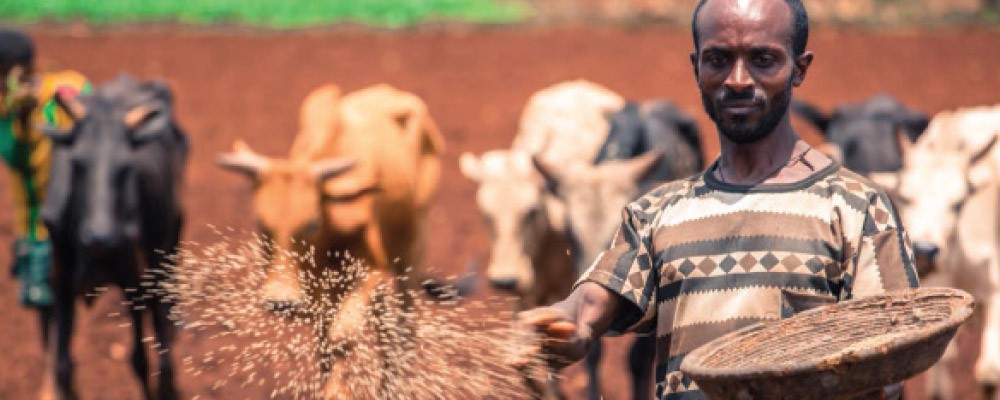
The Crucial Role of Improved Seeds in Ethiopia
Quality seed is a key input for improving crop production. Improving the quality of seeds can increase the yield potential of any crop significantly and thus, is one of the most economical and efficient inputs to agricultural development. However, the seed system in Ethiopia is filled with complex organisational and operational setups that partly thwart the country’s prospect for agricultural revolution. Ethiopian seed system has been confronted with several challenges such as limited capacity of agricultural research centres and distribution channels. Failure of proper utilisation of the already available improved seeds is also a major problem. EBR’s Ashenafi Endale sat down with stakeholders to get to the bottom of the issue and understand what the government is doing to improve the lingering seed system in the country.

 Amanyehun R. Sisay
50 Years of Distinguished Services in Protecting Ethiopia’s Genetic Wealth
Melaku Worede, (PhD) was born in Addis Ababa in 1936. After obtaining his masters and PhD in Genetics and Breeding from the University of Nebraska in the USA, he returned home and got involved in the planning and establishment of the national Plant Genetic Resources Centre, of which he became director in 1979. He served in that capacity until his retirement in 1993.
In 1989, Melaku was bestowed the Right Livelihood Award, an international award conferred to exemplary leaders who offer practical and exemplary solutions to the urgent and pressing challenges facing the world.

After a decade of impressive economic growth, Ethiopia has been experiencing a slowdown in the past two years. The situation is evident in all sectors. However, the construction sector and international trade have suffered more visibly. The lack both of local and hard currencies exacerbated the problem.
However, according to NBE, during the first quarter of the current fiscal year, ETB23.3 billion was disbursed in fresh loans, indicating a 19.7Pct yearly growth. Out of the loans, the housing and construction sector received ETB2.8 billion, 10.2Pct of the total disbursed credit while the import and export sector was also one of the major beneficiaries of the fresh loans amounting to ETB4.4 billion, which is 18.8Pct of the total loans.
EBR’s Tamirat Astatkie talked to stakeholders, experts and consulted relevant reports and documents to compile this story.
