Sani.jpg

Despite its huge potential, little attention has been given for the coffee sub sector in Ethiopia, in which close to 30Pct of the population are engaged directly and indirectly. But in recent years, government started to step up in order to boost coffee production and export as well as promoting value added coffee. One of the steps is re-establishing the Ethiopian Coffee & Tea Development and Marketing Authority last year. The Authority, which is accountable to Ministry of Agriculture and Natural Resources, is expected to enhance the sector’s development as well as making Ethiopian coffee and tea products competent in the global market. EBR’s Mikiyas Tesfaye spoke to Sani Redi, Director General of the Authority, about the changes that are coming to the coffee sub sector.


Counting-the-DEAD.jpg

In Ethiopia, road traffic accident (RTA) has been among the main causes of death. For example, 4,500 people died of RTA in 2016/17. The problem seems staggering in Addis Ababa. In fact, it became one of the top ten causes of deaths in the city in the last decade. The number of deaths due to RTA rose from 395 in 2006/07 to 463 in 2016/17. The city administration, which introduced road traffic safety strategy in March 2017, has launched its action plan recently. With primary targets of halving deaths and injuries by 2023; and providing sustainable transport systems for all by 2030, the action plan establishes a framework to implement a successful road safety programme. EBR explores the strategy and the potential developments to come.


More over the last two decades, the role of the private sector in the Ethiopian economy has been a bone of contention among government officials, business people, experts and the general public.  While government officials stress that the private sector is the engine of the economy and there is enough room for businesses to thrive and grow, businesses and experts argue that the public led investment growth model is crowding out the private sector, making it almost irrelevant in the economy.


As the Chinese Communist Party’s 19th National Congress has unfolded, much of the focus has been on who will occupy the key positions in President Xi Jinping’s administration for the next five years. But China’s future trajectory depends crucially on another group of leaders, who have received far less attention: the technocrats who will carry out the specific tasks associated with China’s economic reform and transformation.


 In July 2014, in its Ethio¬pia Economic Update entitled ‘Strengthening Export Perfor-mance through Improved Com¬petitiveness’ the World Bank advised the Ethiopian government to devalue its currency to speed up the growth of exports. Empirical evidence presented in this report suggests that a 10Pct lower real exchange rate could increase export growth in Ethiopia by more than five percentage points per year and increase eco¬nomic growth by more than two percentage points.


Macroeconomic data from the world’s advanced economies can be mystifying when viewed in isolation. But when analyzed collectively, the data reveal a troubling truth: without changes to how wealth is generated and distributed, the political convulsions that have swept the world in recent years will only intensify.

Consider, for example, wages and employment. In the United States and many European countries, average salaries have stagnated, despite most economies having recovered from the 2008 financial crisis in terms of GDP and job growth.


Broadening-the-Tax-Base.jpg

At the end of the just ended fiscal year, Ethiopia’s parliament approved ETB320 billion budget for 2017/18 fiscal year. The Ethiopian Revenue and Customs Authority (ERCA) also planned to collect ETB199 billion in the year, 62Pct of the approved budget. The tax collection in the preceding year was ETB160 billion. The Authority has been working to increase the tax-to-gross domestic-product (GDP) ratio from 13Pct currently to 17Pct in 2020.
However, the recent effort to increase tax collection, thereby improve the tax-to-GDP ratio, by collecting more taxes ended up being controversial. Tax payers repeatedly voice their frustrations in high sales assessment which implies exaggerated tax amount to be required. Experts also challenge the way the government tries to boost domestic resource mobilisation because efforts to create an enabling business climate for small and informal businesses to go formal and contribute more to the national development endeavour remains minimum. EBR’s Samson Hailu explores the issue to offer this report.


Endalkachew-Sime.jpg

Ethiopian Chamber of Commerce and Sectoral Associations (ECCSA) was re-established in 2003 to safeguard the overall rights and benefits of its members, and serve as a bridge between the business community and the government. ECCSA is an apex organization of chambers and sectoral associations that represent close to 520,000 business enterprises across the country.
The Chamber unifies the voice of the private sector and promotes the sector’s leading role in the economy through advocacy, trade and investment promotion and capacity building. EBR sat down with Endalkachew Sime, the young and dynamic secretary general of the national chamber to learn about its core activities and challenges and the interventions needed to make the private sector the true engine of Ethiopia’s economy.


Smart-Gain.jpg

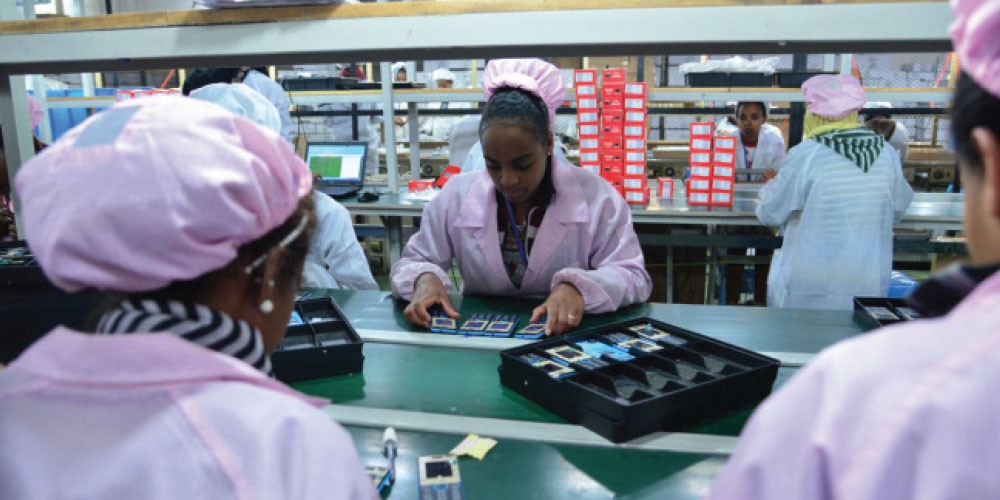
The electronic sub sector is a vital element of the global manufacturing industry. One of the components of the sub sector is the thriving mobile phone production. Despite having a short presence, the sub sector in Ethiopia is performing better, in terms of foreign currency generation, than other manufacturing sub sectors that receive significant government support such as textile and leather. EBR’s Ashenafi Endale spoke with stakeholders about the promise and challenges facing the sector.


Ethiopias-Barren-Esque-Gold.jpg

Because of its geological formations, Ethiopia is endowed with extensive mineral resources such as gold, platinum, niobium, tantalum, nickel, copper, chrome, and manganese, among others. However, the sector is ploughed with a number of challenges that calls for policy interventions. As a result the contribution of the sector to the overall development of the country is low compared with its potential. Especially in recent years, the role of the industry has been declining in export revenue generation. EBR’s Ashenafi Endale has consulted research, authorities and insiders to understand the reasons.


Ethiopian Business Review | EBR is a first-class and high-quality monthly business magazine offering enlightenment to readers and a platform for partners.


2Q69+2MM, Jomo Kenyatta St, Addis Ababa

Tsehay Messay Building

Contact Us

+251 961 41 41 41