
Scramble.jpg

Gulf Nations Cast a Shadow Over the Horn of Africa

The Horn of Africa is one of the most unstable regions in the world. It has long been known for economic, political and humanitarian crises. However, these challenges have not repelled global and regional powers, chiefly because of the region’s strategic geopolitical importance for global security and international trade. This makes the region a battleground among global actors whose economic and security interests exceed their national boundaries. The United States, France, China, the United Arab Emirates, Turkey and Iran have already set up military bases in the region. Germany, Japan and India are also focusing on the area. More recently, with the security bloc formation, spearheaded by Saudi Arabia and Iran respectively, the region has further become a battle of religious, economic and security influences. In fact, the Horn countries have been highly influenced to side with either of the two blocs. Despite this influence, Ethiopia has remained neutral for many years. Recently, however, worries are mounting that Ethiopia will likely side with the bloc led by Saudi Arabia. However, the government claims that it is firm in its neutral position. EBR’s Samson Berhane investigates.


sport_67.jpg

Are football Players in Ethiopia Overpaid?

In Ethiopia, football players are earning jaw-dropping salaries. Indeed, they have skyrocketed during the past few decades. The trend began in 2008 and started to pick up steam over the past five years. While this has helped football players earn millions, it has had an adverse impact on the financial outlook of the clubs. Salaries paid to footballers account for over 90Pct of the budget of the clubs. This coupled with the mismatch between the growth in income and salary expenses of the clubs, had affected their performance and of course their very existence, as EBR adjunct writer Abiy Wondifraw reports.


Secret-Vulnerability.jpg

Ethiopia’s Hidden Victims

Sexual abuse against children is a surprisingly frequent, but unreported issue. To make it worse, most cases go unreported because of the accompanying stigma. While the level of psycho-social assistance for victims is quite low, the abused children can also suffer from depression to substance abuse issues. The names of the victims and their families have been changed to protect their identities. EBR’s Menna Asrat reports.


Golden-Age.jpg

The Ethiopian music industry has been in a state of flux recently. Even though the popularity of Ethiopian songs and singers has increased with the spread of social media and video sharing sites, the advent of new technology in the industry has led to a change in how professionals make and distribute their music. Part of the side effect of this change is the closure of the historic music and record companies. EBR’s Menna Asrat looked into the reasons behind the closure of music labels and their long-lasting impact.


Unlike African cities planned by colonialists, Addis Ababa is a city unique for its indigenous urbanization created out of natural necessities. The expedition to assimilate the south in the mid-1880s concluded with the emergence of a new capital. So, the first settlements of Addis Ababa were set up with a vision of reestablishing the country. These individual settlements known as ‘sefers’, were naturally conceptualized with a top-down hierarchy named after their own chiefs.


Leadership can be discussed from different perspectives such as organizational, political, military, religion, and business. There are also different kinds of leadership styles such as strategic, charismatic, transformational, and ethical. This paper focuses on the perspective of organizational leadership, irrespective of leadership style. Although the paper focuses on organizational leadership in general; it fits business organizations much better.


Eyob-Tesfaye.jpg

Eyob Tesfaye (PhD), a macroeconomist and policy analyst, is among the few scholars who are known for voicing their concerns about the well-being of Ethiopia’s economy. He has served in different governmental positions, including as the Director-General of the Public Finance Institutions Supervisory Agency and Director of the Academy of Financial Studies at the National Bank of Ethiopia. He has been an external examiner of post graduate students at Addis Ababa University and advisor to post graduate students of the London School of Economics and Georgetown University.


ertria_focus_3.jpg

Home to just over half a million people, Asmara has been the capital city of Eritrea since the early 19th century. Although its evolution dates back centuries, many parts of the city were built during the Italian colonial period. Referred to as ‘Little Rome’, its impressive architecture and well designed buildings make Asmara distinct from other cities in the horn of Africa. However, not everything in the city has stood the test of time. From the decaying and severely damaged heritages to poor economic conditions and tough business environment, Asmara is currently struggling to maintain the artefacts of its golden era. EBR’s Samson Berhane visited the city to discover what makes it exceptional: both in a good and bad ways.


ertria_focus_2.jpg

Asmara Keren And Massawa Through Ethiopian Eyes

Although optimism about the future of Eritrea was high in the 1990s, Eritrea now exists in isolation; the lives of ordinary Eritreans is tough and many cities remain underdeveloped. In fact, Eritreans now make up a significant portion of those migrating to Europe on dangerous crossings through Libya. EBR’s Samson Berhane, who travelled to Asmara, Keren and Massawa explores the lives of Eritrean residing in these cities.


ertria_focus.jpg

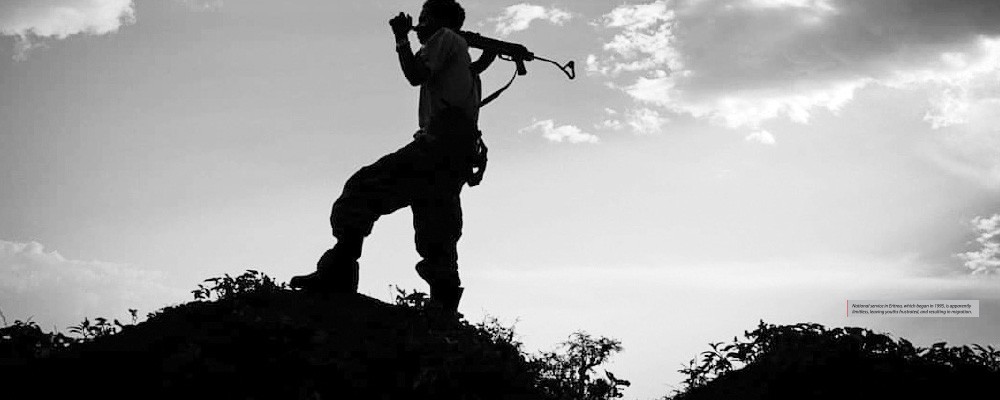
Hardships of National Service Recruits in Eritrea

Eritrea has long had a policy of national service, which conscripts the country’s youth into positions in its army and civil service. However, in spite of legislation limiting the term of national service to 18 months, many people are trapped in their service for many times that limit, even up to nearly 20 years. This, in addition to the already existing issues of low wages, strict anti-desertion laws, and alleges human rights abuses compounds the day to day issues faced by the soldiers. EBR visited Eritrea to get a glimpse at the lives of everyday people who are serving their country.


Ethiopian Business Review | EBR is a first-class and high-quality monthly business magazine offering enlightenment to readers and a platform for partners.


2Q69+2MM, Jomo Kenyatta St, Addis Ababa

Tsehay Messay Building

Contact Us

+251 961 41 41 41