

 Getachew Melaku
In the good old days, Civil Society Organizations (CSOs) in Ethiopia played a significant role, at least when natural and man-made disasters affected lives. They were regarded as development partners of the government following the ousting of the military government. One should also note that this honeymoon was almost following the publication of the internationally controversial book of the celebrated journalist and historical analyst Graham Hancock, ‘Lords of Poverty’ in 1989.
 Alemayehu Geda (Prof.)
In my commentary published on EBR last month I showed that the experiences of many countries indicate privatization does not automatically improve performance; the 1998 scandal involving the Uganda Commercial Bank is a case in point. Moreover, the World Bank’s experience of financial reform in the former Soviet Union drew the conclusion that early privatization does little to improve the quality of the banking system and may be counterproductive when institutions are weak and prudential regulation is underdeveloped. Therefore, it is by no means self- evident that Ethiopia should follow Mozambique’s example of privatizing state banks early in the transition stage.
 Gustavo Adler
Escalating trade tensions are taking a toll on the global economy and are partly responsible for the recent downward revisions to our growth forecasts for 2019/20.
Facing sluggish growth and below-target inflation, many advanced and emerging market economies have appropriately eased monetary policy, yet this has prompted concerns over so-called beggar-thy-neighbor policies and fears of a currency war.
 Nouriel Roubini (PhD)
Unlike the 2008 global financial crisis, which was mostly a large negative aggregate demand shock, the next recession is likely to be caused by permanent negative supply shocks from the Sino-American trade and technology war. Trying to undo the damage through never-ending monetary and fiscal stimulus will not be an option argues Nouriel Roubini (PhD), in a commentary sent to EBR from Project Syndicate.
 Ethiopian Business Review
EBR articles will be written by experts whose authority comes from careful analysis, study, and experience. Articles should be written in clear, simple and jargon-free language in about 1100 words. Articles should represent thought-provoking, often unforeseen ideas in the business and public sector areas. In case the word limits exceed 1100, prior consultation may be needed with editors.

Ethiopian Business Review (EBR) is an English business magazine published by Champion Communications. It is registered with Federal Democratic Republic of Ethiopia, Broadcasting Authority under registration No. 227/04. Champion Communications is registered with the Ministry of Trade, Business License No: 14/670/76602/2004

 Samson Berhane
Is it the Right Model for Ethiopia?
When Ethiopia adopted the developmental state as its growth model almost two decades ago, many did not expect the East African nation would reap massive economic gains. However, the country was able to register one of the fastest economic growths in the world for more than a decade. This contributed to the increase in per capita income and significant reduction of poverty.
Many, on the other hand, discredit the achievements because of gross human rights violations, narrowing political space, and a stifling private sector. The development model has also been criticized for making the state a dominant economic actor in the economy by hugely investing in infrastructure development projects. To finance its huge development plans, the government has excessively borrowed from local and foreign sources. This led the national debt to more than USD50 billion as of June 2019. More than half of the loans were acquired from foreign sources.
As the government was pumping huge supply of money in the economy, the situation created a surge in demand amid a huge supply constraint. The supply was poor because equal volume of investment was not made in the productive sector of the economy, agriculture and manufacturing. The result has been a bulge in the trade deficit because of mounting imports while exports remained stagnant or declining in those years. Now, aiming to address these macroeconomic woes, the administration of Prime Minister Abiy Ahmed has been trying to deviate from the past trends of development. EBR’s Samson Berhane investigates.
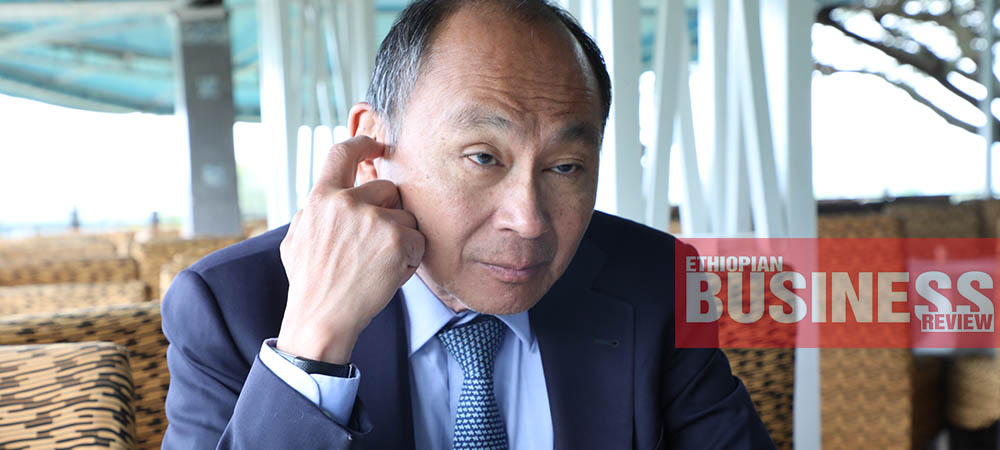
Francis Fukuyama, born in Chicago, USA in 1952, is an American Author and Political Scientist. He received his B.A. from Cornell University in Classics, and his Ph.D. from Harvard in Political Science. Even if, Fukuyama has extensively written on political development and international political economies, he is more known for authoring the book entitled ‘the End of History and the Last Man’, on which he argued that the worldwide spread of liberal democracies and the free-market capitalism and the lifestyle of the West, may signal the endpoint of humanity’s socio-cultural evolution and become the final form of human government.
His other famous publication, ‘Political Order and Political Decay: From the Industrial Revolution to the Globalization of Democracy’, is considered a masterful study of political development.
Fukuyama is currently a senior fellow at Stanford University in California. He is the Director of the Center on Democracy, Development and the Rule of Law.
In his latest book dubbed ‘Identity: the Demand for Dignity and the Politics of Resentment’, he asserts that the demand for recognition of one’s identity, which he deems a fundamental human instinct, is a master concept that defines much of the world politics today. In the book, the Japanese-American stated that the universal recognition on which liberal democracy is predicated has been increasingly challenged by narrower forms of recognition based on nation, religion, sect, race, ethnicity, or gender. If people no longer vote according to their values, such as an attachment to liberty, but by their identities, such as their faith or ethnicity, Fukuyama argues that democracy would cease to function. Indeed, identity is gaining centre stage in politics in many parts of the world today. Ethiopia is no exception.
Two months ago, the 67-year old distinguished professor, on his first trip to Ethiopia, met with Prime Minister Abiy Ahmed (PhD) and discussed on different matters. He gave his latest book on identity politics to the premiere.
Earlier this month, Fukuyama returned to Ethiopia again to train private sector developers. He also gave a public lecture at the American centre in Addis Ababa on “Populism and the State of Global Democracy”. In the sideline of the training, EBR’s Haimanot Ashenafi sat down with the global thinker to discuss about Ethiopia’s economic and political situations.

 Ashenafi Endale
Rice has already become a major staple food in many parts of Ethiopia. This is because of the population growth and urbanization. However, the local rice production does not meet the growing demand due to low yields. As a result, the demand is currently being met by imported rice where in 2018, Ethiopia imported four million quintals of rice worth USD170.69 million. EBR’s Ashenafi Endale spoke with farmers, investors, experts and government officials to shed light on the matter