Housing-Debacle-.jpg

Addis Ababans spend two-thirds of their income on housing. Although there is an additional 250,000 units of new housing demand created every year in the city, only one third is supplied, mainly by government programs.
The contribution of private developers to Addis Ababa’s housing supply is limited to less than 5Pct. The property market is dominated by the land allocation policies adopted to fit only a few as well as the lack of finance and construction materials. Land supply is constrained to generate more revenue for the government, rather than as a vehicle to solve sheltering problems. The city administration is currently finalizing revising the land lease directive, expected to increase land lease prices by several fold.
Government is also devising new state-led property development schemes on state landholdings in the capital, despite inefficiency and resource wastage lessons garnered from condominiums.
In a bid to outmaneuver the land supply grip, private developers are exploiting possibilities in partnering with individual landlords, who contribute their land, to jointly develop apartments and villas. This arrangement has also been picked up by the government which is offering its federal landholdings in the capital to partner primarily with foreign developers to build complexes for housing, business, education, health, and leisure. EBR’s Ashenafi Endale navigated newly surfacing housing options.


pharmasy.jpg

Modernizing and transforming agriculture has been a generational effort skewed in the wrong direction. Production and productivity have been government’s mottos for decades, only to remain lip service. Practically, the farmer’s decision-making power has been overruled by the government with the use of extension programs. Government was not brave enough to consider the farmer as a private and for-profit actor due to political reasons.
As a result, the supply of agricultural inputs, consultancy, and technologies have been monopolized by the government and its extensive extension program. From importation to distribution, from improved seeds to fertilizers, from veterinary drugs to technologies, the agricultural input supply market is monopolized by inefficient state-owned enterprises with the partial involvement of local governments.
Affordable agricultural input is particularly critical for Ethiopia, where the land has been ploughed for millennia. Ethiopia’s small-scale dominated agriculture, where farmers’ per capita land area has diminished to just less than a hectare on average, requires intensive input use to achieve productivity. However, this cannot be achieved when the government is running an inefficient agricultural input market business. Over the last few years, the private sector has been highly interested in installing modern agricultural input shops as a viable business. EBR’s Ashenafi Endale explores the growing potential of private one-stop agricultural input shops in replacing government’s incapacitated role in agriculture.


Lensa-Mekonnen.jpg

Lensa Mekonnen is assigned to lead the Land Bank and Development Corporation (LBDC), the latest SOE established just eight months ago. The corporation audited 3,700 hectares of landholdings under federal institutions and enterprises—constituting 5.2Pct of Addis Ababa’s 54,000 hectares.
The corporation has embarked on a state-led property development endeavor and is already attracting world-class developers and financers towards developing housing projects, convention centers, seven-star hotels, tertiary hospitals, and specialized education centers on 30 prime locations identified in Addis Ababa, including the redevelopment of Ghion Hotel. The LBDC will indulge in a minimum 20Pct equity share in the projects, to be developed under a build, operate, and transfer PPP modality. The corporation has also identified government districts where public institutions will be relocated to in a clustered fashion.
Given the land scarcity in Addis Ababa, LBDC’s efforts are a relief for investors with cash looking for prime locations, although Lensa says international developers are given priority. Yet, her agility in availing public holdings to private developers is showing results faster than previous governmental processes towards land provisioning, where land is owned by the public and government and is very scarce as hens teeth in the market.


covide-19-vacsin.jpg

The first coronavirus disease vaccine injections taking place at Eka Kotebe COVID-19 Hospital on March 13, 2021 in the presence of high-level government officials and other notable Ethiopians. Frontline health workers were first to take the jab.
The first COVID-19 positive case and vaccine were registered in Ethiopia on the same day of March 13 in 2020 and 2021, respectively, whether accidental or planned. The world seemed doomed by the invincible virus since the beginning of 2020. After unprecedented death, chaos, and ultimate test to science, new vaccines were created for the new pandemic.


African-continental.jpg

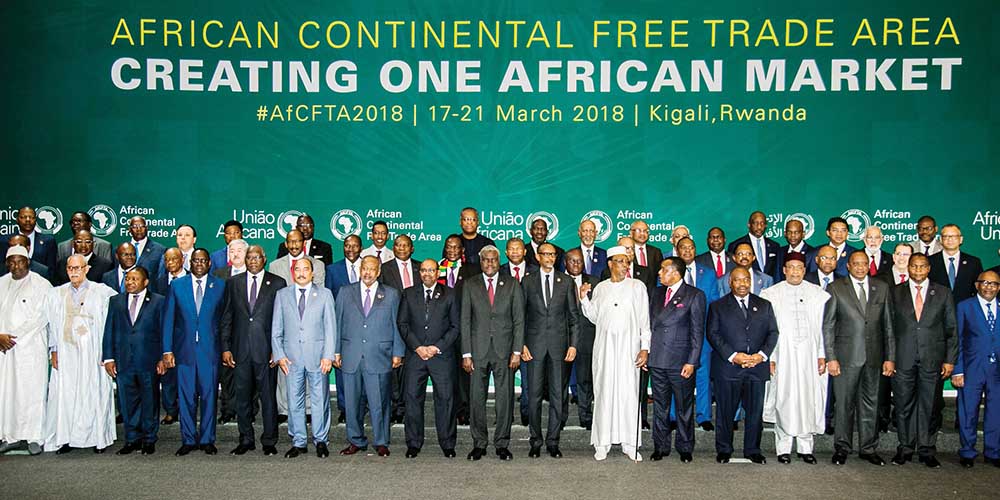
Despite the COVID-19 pandemic and other teething problems, African countries opened their markets in January 2021 under the African Continental Free Trade Area (AfCFTA). The new market, which allows for the duty-free trade of goods and services across borders, is expected to lift up to 30 million Africans out of extreme poverty. It is also expected to boost intra-African trade, promote industrialization, create jobs, and improve the competitiveness of African industries on the global stage. However, the new trade block is encountering problems from its birth. African countries, fearing trading through AfCFTA will immensely cost their economies, are retreating. In fact, more than 20 African nations, including Ethiopia, have not fulfilled necessary requirements to start trading under the agreement. EBR’s Ashenafi Endale explores.


Addis-Gezahegn-marathoner.jpg

In the shadow of Abebe Bikila’s colossal fame is Addis Gezahegn, the first Ethiopian and African woman to win a major marathon. She finished the 1991 Rotterdam Marathon in 2:35:04, a record at the time for an African woman. She also competed in Tokyo in 1990, the Barcelona Olympic Games in 1992, and a in a total of 30 international tournaments.
She usually ran in men’s races, as separate races for women were almost nonexistent. Addis participated in the annual Abebe Bikila Marathon for men in Addis Ababa in 1989, her first ever 42 kilometers. Her spontaneous performance and non-fatigable physique could not pass unnoted by talent explorers of the national squad. At 155 centimeters high and weighing 45 kilograms, Addis still runs as a life experience, though she retired in 2011. EBR’s Abiy Wendifraw, chatted with the sport’s stuntwoman about her captivating story.


digital-art.jpg

Gone are the days when only humans play story characters. A human character does not have to put on excessive costumes to play the character of legends who passed even before photography was invented. With digital drawing pads, computers, and software programs, two- and three-dimensional visual characters are developed with even more features and abilities than their human counterparts. The only limitation, however, is that digital art cannot replace live theater.
The demand for digitally generated visual artworks is growing in Ethiopia, mainly from film makers, videogame enthusiasts, and visual advertisement agencies. However, there are only few digital artists as not even the traditional art has fully matured in Ethiopia. EBR’s Samuel Habtab, assessed the baby steps digital visual art is taking in Addis Ababa.


cleaning-heros.jpg

The life of waste collectors in Addis Ababa is not dissimilar to a burning kindle. They make the capital clean and bright while their very lives are hung by a thread. Each day, they move from door to door with pushcarts to collect garbage, just to get ETB0.71 per kilogram of collected waste. They have families but are homeless and excluded from social structures.

However, even that has become luxury for the close to 400 residents of a garbage collection site who recently lost everything in a fire accident and have to return to the streets with babies, elders, and pregnant women. Ironically, the city administration, local officials, and NGOs are all silent even a month after the major fire accident damaged all that they had. The fairy Addis Ababa is deaf to a number of flaws in its urban texture, all the while being a diplomatic hub. EBR’s Mersha Tiruneh investigates how the lives of hundreds of Addis Ababa’s cleaning workers have gone down the dust bin.


Samrawit Fikru’s Account of the Difficulties

The world has come to a grinding halt because of the coronavirus pandemic. Factories have stopped operations. Corporations that generated millions of dollars every day have ceased functioning. No one seems immune to the health, economic, and social hazards of the ongoing crisis. With no end in sight yet, businesses are being forced to lay off their highly valued employees as their expenses surpass the revenues they generate.


The accelerating rollout of COVID-19 vaccines in many advanced economies has set the stage for rapid recovery in the second half of this year and into 2022. Although growth in digital and digitally enabled sectors will level out somewhat, high-employment service industries will ride a wave of pent-up demand.


Ethiopian Business Review | EBR is a first-class and high-quality monthly business magazine offering enlightenment to readers and a platform for partners.


2Q69+2MM, Jomo Kenyatta St, Addis Ababa

Tsehay Messay Building

Contact Us

+251 961 41 41 41