

Africa Faces $108B Infrastructure Gap as EACE Convention Urges Better, Faster Engineering
Natran Abdulfetah
#EBR_News Sep 30, 2026
Africa faces an infrastructure financing gap of $68 billion to $108 billion according to African Development Bank reports, alongside critical shortages in skilled professionals and engineers needed to drive a historic construction wave that requires building as much infrastructure in the next 25 years as was achieved over the past century.
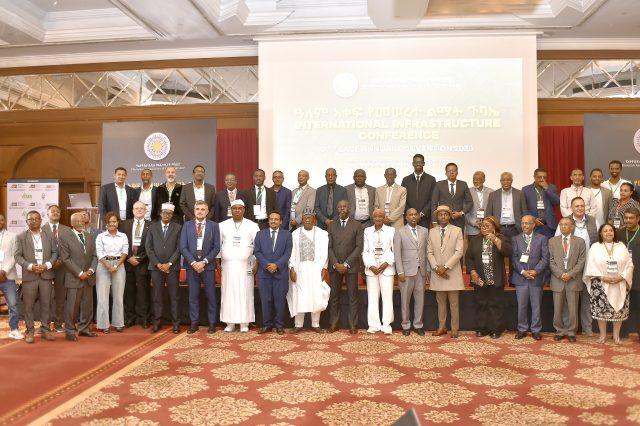
This reality took center stage at the EACE 27th Convention & International Infrastructure Conference 2026, held at the Sheraton Addis Hotel from September 28–29 in Addis Ababa. Convening engineers, policymakers, contractors, and international partners, the landmark summit focused on how the continent can overcome its financial and skill constraints to deliver sustainable development.
Amanuel Hailemariam, President of the Ethiopian Association of Civil Engineers (EACE), emphasized that physical development must go hand-in-hand with social responsibility.
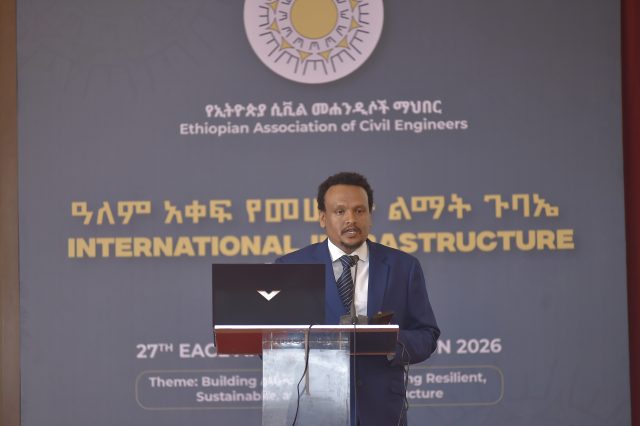
“Whatever we do, we should include the word sustainability,” Amanuel stated, stressing that with 70% of Africa’s population consisting of youth, he noted that the sector must be inclusive of everyone affected by projects. Pointing out that many modern corridor projects are driven by young engineers running small and medium enterprises, he called for expanding this model across Africa and integrating financial support into regional projects.
On the national front, Ethiopia’s construction sector is experiencing rapid expansion, with projected annual growth reaching 7.7% through 2029. However, Esayas Gebreyohaness (PhD), Associate Professor in Civil and Environmental Engineering at Addis Ababa University, warned that the core challenge has shifted from simple volume to execution quality.
“Massive infrastructure development has changed the economic and physical landscape of the country,” Esayas noted. “Although constructing more is important, the key challenge now is constructing better, faster, safer, and in a more resilient manner.”
Highlighting massive undertakings, such as a national housing initiative targeting 1.5 billion in development over five years, Esayas stressed the need to scale up standards, cost efficiency technology, serviceability, safety, and logistical supply chains. To navigate rising high-rise building demands, complex complexities, and natural or man-made disasters, he announced that a comprehensive set of 48 newly revised engineering codes addressing modern global technologies and localization will be launched soon.
The revision aims to enhance structural robustness and connect design quality with operational sustainability, material usage, and local adaptation.
The event brought together international delegates from several countries, including Nigeria, Somalia, Italy, the Netherlands, Germany, Cyprus, Namibia, Tunisia, Ghana, and the UK.
On the second day of the event, Memorandums of Understanding (MoUs) were signed between Midroc Investment Group and PMI Global to build workforce capacity, as well as between the Somalia Engineers Association and the Engineering Professions Association of Namibia.
The consensus remains that bridging Africa’s multi-billion-dollar infrastructure gap requires aligning robust financial frameworks with modernized regulatory codes, uncompromised safety, and intensive empowerment of the continent’s youthful engineering workforce.
 Betegbar Yaregal