

Wegagen Bank Profit Grows 12% to 4.3 Billion in 2025/26
#EBR_News Sep 19, 2026
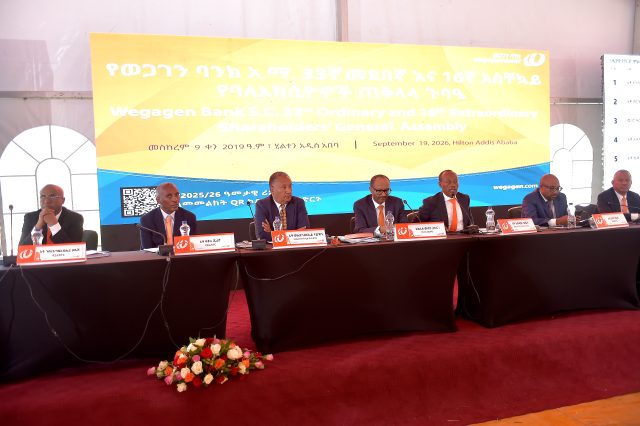
Wegagen Bank S.C. reported profit before tax of 4.3 billion birr for the 2025/26 fiscal year, a 12 peercent increase from 3.85 billion birr the previous year,according to the bank’s financial performance presented at its 33rd Ordinary and 16th Extraordinary Shareholders General Meeting, held at Hilton Hotel Addis Ababa on Saturday.
The net profit followed an income tax expense of 1.15 billion birr on a profit before tax of 4.3 billion birr, itself a 12 percent increase from 3.85 billion birr the previous year.
Basic and diluted earnings per share stood at 34.40 percent for the year, down from 46.10 percent in 2024/25, a decline that comes even as absolute profit grew, reflecting the bank’s paid-up capital expanding from 7.0 billion birr to 10.09 billion birr during the year, a 44 percent increase in outstanding capital against which earnings are measured.
The bank’s profit growth has moderated over the past two fiscal years after a sharper rise before that: net profit rose from 1.60 billion birr in 2023/24 to 2.78 billion birr in 2024/25, a 73 percent increase, before growing a further 13.6 percent to 3.15 billion birr in 2025/26.
Presenting the fiscal year report to shareholders, Board Chairperson Abdishu Hussein said Wegagen Bank expanded its balance sheet, strengthened its capital position, and advanced key business and technology initiatives despite domestic and global challenges.
According to Abdishu, total assets rose 32 percent to 111.3 billion birr, deposits increased 23 percent to 81.3 billion birr, and gross loans and advances grew 26 percent to 67.3 billion birr as of June 30, 2026.
He said foreign currency generation reached $366 million, marking a 34 percent increase from the previous fiscal year, driven by export proceeds, foreign exchange market dealings, and remittances.
Chief Executive Officer Aklilu Wubet (PhD) said the bank’s priorities extend beyond financial results, focusing on building a customer-centric, digitally enabled, and operationally efficient institution. He said the bank’s new five-year strategy prioritises investments in systems, people, partnerships, and risk management to deliver sustainable results.
Abdishu also highlighted the bank’s digital lending platform, Efoyta, which he said disbursed more than 9 billion birr to 430,890 borrowers, primarily women, youth, and MSMEs, supporting financial inclusion. Beyond digital lending, the bank added 639,038 new deposit accounts during the year, a 15 percent increase, bringing total deposit accounts to just over 5 million.
Mobile banking subscriptions rose 21 percent to 4,087,775, while internet banking subscriptions jumped 86 percent to 41,494 and cardholders increased 45 percent to 537,651. A digital wallet partnership with E-Birr yielded 664,347 E-float accounts, supported by a network of 7,445 agents.
The bank’s loan portfolio remained diversified across sectors, led by import financing at 22.2 percent, construction at 19 percent, export financing at 18.2 percent, domestic trade and services at 15 percent, manufacturing at 13.4 percent, and transport services at 8.2 percent, with digital lending accounting for the remaining 2 percent.
The bank’s Interest Free Banking service mobilised a net deposit of 143 million birr during the year, a 3 percent increase, bringing total outstanding interest-free deposits to 4.9 billion birr.
Total income for the fiscal year reached 16.4 billion birr, up 21 percent from 13.5 billion birr in the preceding year, while total expenses grew 25 percent to 12.1 billion birr, driven primarily by interest expense at 38.3 percent of the total and employee salaries and benefits at 36.5 percent.
Return on Average Assets stood at 3.2 percent and Return on Average Equity at 20.9 percent for the year. Total equity increased 35 percent to 17.3 billion birr, contributed by 15,598 shareholders, up from 7.0 billion birr in paid-up capital the previous year.
On institutional expansion, the bank said it onboarded 485 new institutional partners during the fiscal year, including 185 schools, 158 health centres, 61 entities across unions and utilities, 43 savings and credit cooperatives, and 38 water and sanitation offices.
The bank’s physical distribution network expanded to 458 branches, supported by 398 ATMs, 651 point-of-sale terminals, and 7,445 agents. Workforce, including contract personnel, stood at 5,555 employees as of June 30, 2026, with the bank providing 7,138 staff training opportunities during the year, backed by an investment of 94.5 million birr.
Over the five-year period from 2021/22 to 2025/26, the bank’s growth has been sustained across key metrics. Total deposits increased from 33.9 billion birr to 81.3 billion birr, gross loans and advances grew from 30.1 billion birr to 67.3 billion birr, and total assets rose from 43.1 billion birr to 111.3 billion birr.
Total capital expanded from 5.6 billion birr to 17.3 billion birr, and paid-up capital increased from 3.4 billion birr to 10.1 billion birr over the same period. Profit before tax rose from 572 million birr in 2021/22 to 4.307 billion birr by the end of 2025/26.
In his message to shareholders, Abdishu described the operating environment during the fiscal year as one of significant economic, regulatory, and competitive change.
He said global economic activity remained resilient but uneven amid geopolitical uncertainty, trade tensions, elevated debt levels, and volatility in commodity and energy markets, with the outbreak of war in the Middle East introducing a further shock that disrupted energy markets and international trade routes, including severe interruptions to shipping through the Strait of Hormuz.
He cited the International Monetary Fund’s July 2026 World Economic Outlook update, which projected global growth at 3.0 percent for 2026, revised down 0.1 percentage points from its April 2026 projection, with the IMF noting that the global disinflation process had stalled temporarily due to the conflict and associated energy-price pressures.
Domestically, Abdishu said Ethiopia continued to advance its macroeconomic reform agenda while maintaining strong economic activity, with growth projections of 10 percent.
He said headline inflation declined to single digits by December 2025 and remained within that range through March 2026, before edging upward again later in the year, largely reflecting external shocks stemming from the Middle East conflict and resulting disruptions to fuel supplies.
He said these developments generated broader spillover effects on domestic production, monetary and fiscal policy conditions, and the implementation of ongoing macroeconomic reforms, while changes to the risk-based capital adequacy framework and the liberalisation of interest rates and foreign-exchange rates continued to shape a more market-oriented and competitive banking system during the year.
 Betegbar Yaregal
 EBR
EBR