

Can Bayer’s Nitrogen-Fixing Wheat Reduce Ethiopia’s Fertiliser Bill?
By Eyoel Endashaw
EBR_Analysis | Nov 16, 2026
German multinational life sciences company, Bayer, which operates in pharmaceuticals, consumer health and agricultural science will test a wheat variety that enlists soil bacteria to supply its nitrogen in a country where the state spends heavily to import and subsidise fertiliser. The trials will show how much of that bill it can cut.
Bayer’s plan to test a nitrogen-fixing wheat in Ethiopia has an obvious appeal. Bayer CEO Bill Anderson, who visited Ethiopia on November 11 and 12, told EBR during a field visit to Gimbichu, Oromia, that the variety brings nitrogen from the air into the ground to make its own fertiliser.
He expects farmers to produce the same amount of wheat with one third or even 50% less fertiliser. Testing in Ethiopia will establish the exact savings, and the country will be the first in Africa to run the trials, according to Anderson.
The science behind this type of wheat explains why the savings could be large. Wheat, unlike beans and peas, has no root nodules to host nitrogen-fixing bacteria. Researchers at the University of California, Davis, used gene editing to make wheat produce more of a natural compound called apigenin, which the plant releases through its roots. It prompts soil bacteria to form protective biofilms that let them fix nitrogen the wheat can absorb.
The bacteria do the fixing, and the plant supplies the signal. The work was published in August 2025 in Plant Biotechnology Journal, and Bayer Crop Science was among its supporters. Wheat is also a natural target for the technology, since it takes the biggest share of the world’s nitrogen fertiliser, about 18% of the total.
The scale of Ethiopia’s fertiliser spending explains the interest. According to the Ministry of Agriculture’s June briefing, the subsidy in the 2025/26 season was 84 billion birr, or 4,972 birr on every quintal sold to farmers.
The federal budget for 2026/27 raises the fertiliser subsidy to 100 billion birr, in response to higher fuel and fertiliser costs linked to tensions in the Middle East. Supply is also expanding.
The Ministry reports that available supply this season reached 19.1 million quintals, including 7 million carried over from the previous season, with 10.7 million quintals distributed to farmers between mid-November and June 17. For 2027/28 it plans to procure about 22.9 million quintals, with contracts already signed for 20.9 million.
National Bank of Ethiopia customs data show imports of 1.337 million tonnes worth USD 1.047 billion in 2024/25, roughly USD 780 a tonne on average. A variety that cuts the fertiliser needed per hectare would ease pressure on farmers’ budgets and on public finances.
The price outlook adds to the case. The IMF’s October 2026 Regional Economic Outlook Update for Sub-Saharan Africa projects global fertiliser prices rising by 26 per cent in 2026. For a country that buys fertiliser abroad in foreign currency, higher world prices raise both the farm-level cost and the size of the subsidy.
The nitrogen focus fits Ethiopia’s import mix. Urea, a nitrogen fertiliser, accounted for 43.8% of fertiliser imports by product weight in 2023, while other nitrogen-phosphorus (NP) compounds made up another 54.9%, according to FAOSTAT. Nitrogen is a central part of what Ethiopia buys abroad, which is where the variety’s savings would be concentrated.
Wheat has also become one of the country’s biggest fertiliser-using crops. According to the Ministry of Agriculture, dry-season irrigated wheat grew from 20,000 hectares in 2020 to 3.5 million hectares in 2025, while rainy-season cultivation rose from 1.8 million to 4.2 million hectares. In 2025, 7.8 million hectares were cultivated across both seasons, producing 280 million quintals of wheat.
The most recent crop-level fertiliser breakdown, from the Ethiopian Statistics Service’s 2021/22 Meher-season survey of private smallholder holdings, recorded about 3.8 million quintals applied to wheat, roughly 19% of the 19.9 million quintals used. That survey excluded Tigray and predates the irrigation expansion, so it serves as a historical smallholder benchmark and does not describe wheat’s current national share. The savings from the new variety will follow from how widely it is adopted and how its seed is priced against conventional varieties.
Anderson also outlined Bayer’s longer-term role in Ethiopian agriculture. The company already produces seeds in Ethiopia through contracts with local companies and farmers, and he told EBR that it “absolutely” intends to increase that output and hopes eventually to build its own factory. He pointed to Bayer’s recent seed-processing investment in Zambia as a model for Ethiopia.
The facility works with 5,000 local farmers who grow maize seed, and its output, he said, is sufficient to produce food for 30 million people. He added that Bayer’s investment focus in Ethiopia is on expanding local seed production rather than pharmaceutical manufacturing.
Producing seeds closer to the farmers who plant them could shorten supply chains and give local growers a greater role in the seed industry.
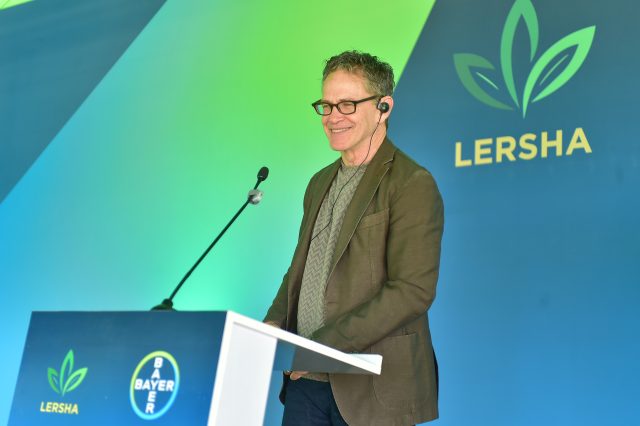
Bayer’s partnership with agritech firm Lersha, formalised during the same visit, supplies the access side of the equation.
It is expected to reach close to 750,000 farming households, about 3.75 million people, by linking smallholders to inputs, financing, digital advisory services, health support and market opportunities. These are the channels through which a nitrogen-fixing variety would reach farmers.
With a subsidy of 100 billion birr in the current budget, tens of millions of quintals of fertiliser to procure and global prices rising, a wheat that draws on soil bacteria for its nitrogen speaks directly to Ethiopia’s fertiliser costs. The field trials will show how much of that potential the variety delivers.
 Betegbar Yaregal