

Seventeen years on, Ethiopia’s private geothermal push is still stuck, and the market design is partly to blame, IEA says
Betegbar Yaregal
#EBR_News Nov 12, 2026
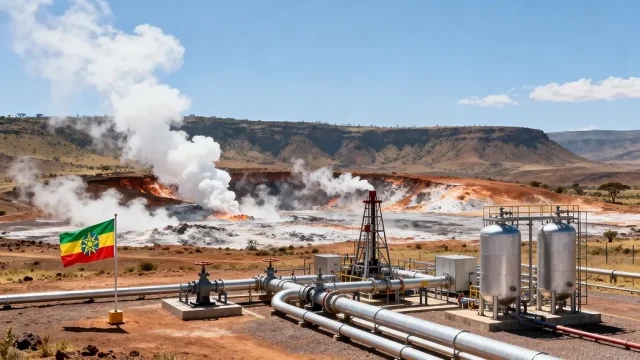
Ethiopia’s flagship private geothermal project is moving again, but the country still has just one operating geothermal plant and no private project producing power, according to the International Energy Agency’s (IEA) new *Ethiopia 2026: Energy Policy Review*.
The report links the slow progress to a single-buyer power market, high financing costs, scattered institutional responsibilities and weak finances at the state utility, and warns that these problems are holding back wider private investment in the sector.
According to the report, Ethiopia’s technical geothermal potential exceeds 10,000 megawatts (MW), but deployment is below 0.1% of installed capacity. The country’s only operating plant is Aluto-Langano in Oromia, commissioned in 1998 with 7.3 MW.
Newly drilled wells have confirmed about 25 MW, and a World Bank-backed expansion targets 70 MW, the IEA said. The government aims for 2.5 gigawatts (GW) of geothermal power by 2030.
The Corbetti project, near Shashemene in Oromia, is the clearest test of whether private capital can change that. The report indicates that it began in 2009 with Reykjavik Geothermal, when geothermal resources were still legally classified as minerals, and that it signed a 25-year power purchase agreement with Ethiopian Electric Power (EEP) at USD 75.3 per megawatt-hour.
As of 2024, it had only reached exploratory drilling, with three wells underway, according to the IEA. The report adds that in June 2026 the Private Infrastructure Development Group (PIDG) and Taranis Operations signed a convertible loan agreement to support the next stage, as part of a USD 27 million equity investment.
That deal has since moved forward. EBR reported on October 23 that Taranis, a family-owned investment and project development company, completed the acquisition of a majority interest in Corbetti HoldCo Limited, the project’s operator, and plans to commit up to USD 27 million to lead the next phase.
It also reported that PIDG, through its arm InfraCo Africa, retains a minority stake of about 40%, and made a further equity contribution of USD 7.2 million alongside Taranis. According to Taranis, the project signed a power purchase agreement and an implementation agreement with EEP and the Ethiopian government in 2020.
The first concrete step followed within days. On October 29 that Corbetti signed a contract with UK-based Marriott Drilling Group to drill up to four exploration wells in the Corbetti Caldera. According to the project statement, a drilling rig is due on site in the coming months, with drilling expected to begin early in the new year.
The exploration is meant to confirm the resource, a step required before financial close, when funding is fully secured and construction can start. The first phase is then expected to support a 50 MW plant, with a second phase planned to reach 150 MW, the statement said. The IEA notes a potential expansion up to 500 MW.
Not every project has fared as well. Tulu Moye, which signed a 25-year agreement at USD 69.5 per megawatt-hour, entered a “pause and reassess” phase by mid-2024, the IEA said. It cited unproductive wells, financing constraints and security concerns, including armed activity that forced a temporary withdrawal of personnel.
By early 2026, talks to resume had begun, but the project had not fully restarted. Five further projects, planned by Ormat Plc and Cluff Geothermal, are still at the power purchase agreement negotiation stage, the report notes.
Solar has had a similar record, according to the IEA. The first auction in 2016 for a 100 MW project at Metehara was won by Enel Green Power at USD 58.98 per megawatt-hour, but the company could not secure debt because of foreign exchange restrictions and uncertainty over repatriating profits, the report says.
In 2019, ACWA Power won two projects totalling 250 MW at a record-low USD 25 per megawatt-hour, but both were terminated because of financing delays, foreign exchange problems and regional conflict.
A new round for the 125 MW Gad II and 100 MW Weranso projects has a final award expected by the end of 2026.
The IEA pointed to structural obstacles beyond finance. Ethiopia has no single geothermal authority, unlike Iceland or the Philippines, and responsibilities are split between the Ministry of Water and Energy, the Ministry of Mines, the Ethiopian Geological Institute, the regulator and EEP, the report says.
Approval of independent power projects can take two to three years, compared with six to nine months in Kenya, it added. Even with concessional support, long-term geothermal tariffs typically exceed USD 100 per megawatt-hour, which makes the technology uncompetitive against cheaper renewables under current conditions, according to the report.
The most striking finding concerns the single-buyer model. The IEA said large consumers cannot contract directly with geothermal or other independent producers, physical bilateral power purchase agreements are not permitted, and virtual agreements are underdeveloped.
That matters because the Digital Ethiopia 2030 roadmap is expected to drive data centre growth, and the report notes that data centres elsewhere, including Google, Meta and Microsoft, have signed direct deals for firm geothermal power.
In Ethiopia, geothermal projects instead depend on utility offtake and donor-backed financing rather than market signals, the IEA said.
The government has taken some steps. The report says the Foreign Exchange Amendment Directive No. FXD/04/2026 eases approval of external loans and supplier credits, allows bank guarantees for private loans, and gives banks more authority to approve profit repatriation.
A Regional Liquidity Support Facility, backed by KfW and Norad through the African Trade & Investment Development Insurance, will protect independent power producers from delayed payments by public offtakers, according to the IEA. Even so, developers in Africa face a cost of capital two to three times higher than in advanced economies, and tariff reform adds regulatory risk for long-lived investments.
 Betegbar Yaregal