
Ethiopia’s 9.8% Growth Rebound Masks One of Africa’s Weakest Tax Bases, AfDB Report
Betegbar Yaregal
#EBR_News Nov 5, 2026
Ethiopia’s economy grew by 9.8% in the 2024/25 fiscal year, but the government collected tax equal to only about 7.8% of GDP, a level that ranks among the lowest in sub-Saharan Africa. That gap between growth and revenue runs through the African Development Bank’s Country Focus Report 2026 on Ethiopia.
According to the report, the country’s development financing challenge is less about a shortage of financial instruments than about credibility, coordination and execution.
The headline numbers are strong. The report says industry expanded by 13%, mining surged by 205.4% and manufacturing grew by 10.3%, while inflation fell to 16% from a peak of 33.8% in 2022/23. Exports grew by 119%, narrowing the current account deficit to 0.2% of GDP, and the fiscal deficit including grants eased to 1.6% of GDP.
The bank credits Home-Grown Economic Reform 2.0, including the shift to a floating exchange rate and interest-rate-based monetary policy, for restoring some credibility.
The scale of what Ethiopia must fund makes the revenue shortfall more pressing. According to the report, the country needs to mobilise US$608 billion by 2030 and about US$5 billion annually between 2025 and 2050 to implement its Long-term Low Emissions Development Strategy. A further sum equal to 13.2% of GDP is needed each year to support structural transformation.
The bank says the 15% tax-to-GDP ratio targeted under the National Medium-Term Revenue Strategy is the level generally required to finance the Sustainable Development Goals, almost double today’s 7.8%.
The revenue picture is far weaker than the growth figures suggest. The report says Ethiopia’s overall tax buoyancy, which measures how far revenue responds to economic growth, stands at 0.91, below the African average of 1.05.
It adds that recent gains came mainly from import surcharges and excise duties on telecom services rather than from a broad expansion of the tax base. The tax structure, it says, relies heavily on border taxes, excise duties and indirect taxation, while personal and business income taxes contribute relatively little.
The regional comparison is stark. The report puts the African average tax-to-GDP ratio at 13.4% and the regional average at 11%, with Ethiopia well below both, and notes that the sub-Saharan African average is roughly 18%.
Personal income tax peaks at 35% in Ethiopia, which the report shows is above the regional average of 28.7%. The rates are therefore not low, but few people and firms actually pay them.
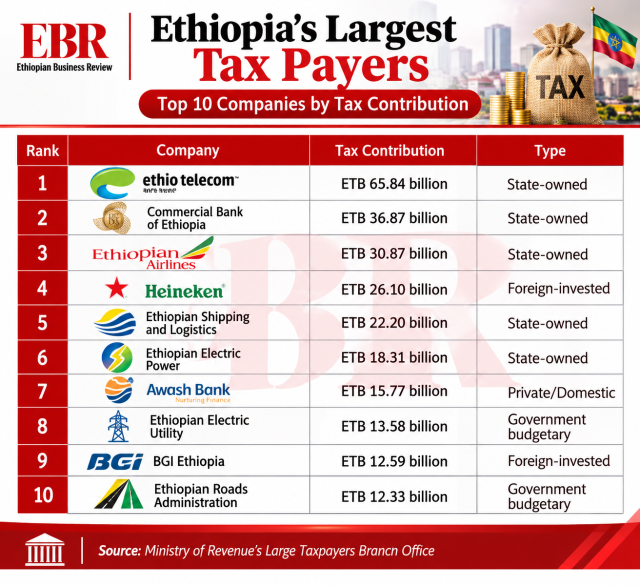
Figures that EBR reported in August from the Ministry of Revenue’s Large Taxpayers Branch Office show how narrow that base is in practice. The office collected 522.67 billion birr in 2025/26 from 746 registered taxpayers, yet 29% of them generated 80% of the total. Just 31 state-owned enterprises paid 217.87 billion birr, or 42% of branch revenue, and the top ten taxpayers together accounted for 48.71%, led by Ethio Telecom at 65.84 billion birr.
The AfDB’s finding that gains came from telecom excise and border measures fits this pattern: the revenue is coming from payers the state already knows well, many of which it owns.
The same state-owned enterprises that dominate tax payments also worry the bank. According to the report, higher SOE dividends helped raise non-tax revenue, but SOE-related fiscal pressures, weak oversight, quasi-fiscal activities and contingent liabilities remain a major constraint on the budget and on private-sector confidence.
In effect, the state leans on its own companies for revenue while their balance sheets pose a risk to public finances.
The same concentration is now shaping targets. According to the branch’s own planning documents, it has been assigned 816.70 billion birr for 2026/27, which is 56% above what it collected last year and represents 76% of the country’s entire domestic tax revenue target.
That leaves a very large share of the national revenue plan resting on fewer than 750 firms. The AfDB report points to the risk on the other side of the ledger.
Informal activity accounts for an estimated 30–35% of GDP and 70–80% of employment, and IMF estimates cited in the report place Ethiopia’s tax capacity at 17–20% of GDP, implying large revenue losses linked to informality and weak compliance.
The report also describes what this does to the businesses that are inside the net. A narrow tax base, it says, forces high effective tax burdens onto a small pool of formal firms and workers, which reinforces the incentive to stay informal.
The Large Taxpayers Branch Office acknowledged related problems among smaller taxpayers, including under-declared sales, fake invoices and late audited financial statements.
For small and medium-sized businesses, whose combined contribution is modest, the experience of tax collection remains a frequent source of frustration, and the AfDB’s prescriptions read like a response to it.
It recommends moving from blanket audits to risk-based enforcement, cutting face-to-face interactions through digital systems, and offering simplified presumptive regimes to micro-firms. It also argues that formalisation should start with simple registration, licensing and digital payment inclusion, and only later bring taxation and enforcement at low rates.
There is evidence that better administration pays. The report says reforms such as digitalisation, e-filing and e-payments, together with a stronger Large Taxpayers Office, contributed to an average 24.8% rise in revenues over three years.
It adds, however, that fragmented taxpayer registries, weak risk-based audits and uneven capacity at regional level persist. The bank says Ethiopia’s constraints lie “more in implementation than policy design”.
Debt adds urgency. The report states that Ethiopia’s debt is assessed as unsustainable and that the country remains in debt distress, with total public and publicly guaranteed debt of US$71.34 billion, or about 34.8% of GDP.
Ethiopia agreed a memorandum of understanding on key terms with the Official Creditor Committee under the G20 Common Framework in July 2025, and with Eurobond holders in January 2026, but bilateral agreements are still to come.
The bank projects the fiscal deficit will widen to 2.5% of GDP in 2025/26, driven by rising debt-service costs, security spending and weak tax administration.
The cost of that debt reaches public services. External debt stands at US$31.3 billion, or 15.5% of GDP, and the report says external debt servicing absorbed about 15% of government revenue between 2020 and 2023.
It warns that interest payments risk squeezing spending on health, and that high debt burdens limit fiscal space for education, healthcare and infrastructure.
Outside shocks could make matters worse. The report’s analysis of the Middle East conflict says more than 90% of Ethiopia’s international trade passes through Djibouti, so disruption in the Red Sea would hit the country directly.
It adds that Ethiopia imports nearly all its fuel and over 90% of its nitrogen fertiliser from Gulf states. A major oil price spike could raise inflation by around three percentage points, the report warns.
The benefits of growth have yet to reach many households. The report cites the 2024 Multidimensional Poverty Index, under which 68.7% of Ethiopians are multidimensionally poor, and puts youth unemployment at 23.1% and urban unemployment at 19.2%.
Remittances reached about US$7.1 billion in 2024, exceeding foreign direct investment of around US$4.0 billion and official development assistance of about US$5.4 billion, though the bank says they are used mostly for household consumption rather than investment.
The bank also sees untapped potential beyond taxes. According to the report, mining contributes only about 1% of GDP and revenues, 14% of exports and around 54,000 jobs, against an ambition of 10% of GDP by 2030.
Less than 11.7% of Ethiopia’s estimated 48,030 MW of hydropower potential is exploited, and distribution losses are near 22%. Coffee earned about US$2.6 billion from roughly 470,000 tonnes.
The AfDB still projects growth of 7.0% in 2025/26 and 8.5% in 2026/27, with inflation easing to 14.7% and then 8.7%. It cautions that this depends on reform progress, the resumption of external financing and domestic stability, with conflict in Amhara and Oromia, renewed tensions in Tigray and frictions with Somalia among the downside risks. Its sequence is “stabilisation first, mobilisation second, and scaling last”.
 Betegbar Yaregal
 EBR