

NBE Holds Policy Rate at 16% as Broad Money Growth Climbs to 40.2%, Governor Says Inflation Is Supply-Driven
#EBR_News Nov 3, 2026
The National Bank of Ethiopia (NBE) has kept its policy rate unchanged at 16 percent, even as its own figures show broad money growing at 40.2 percent year on year, well above projected nominal GDP growth.
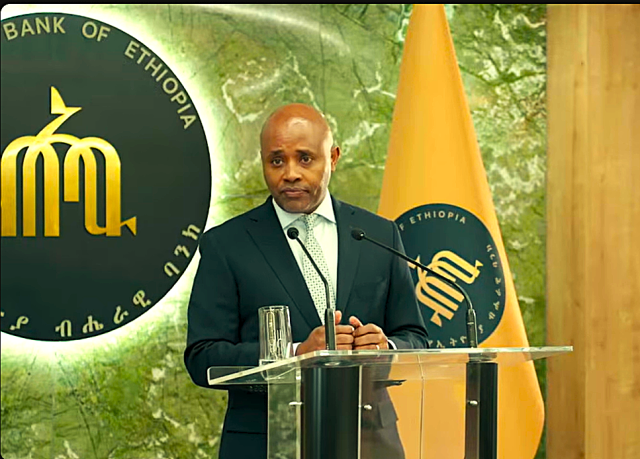
The Monetary Policy Committee (MPC) announced the decision after its 8th meeting, which was presented today at the bank’s headquarters in Addis Ababa. The corridor band of plus or minus 300 basis points was also left unchanged.
According to a press release presented by National Bank of Ethiopia Governor Eyob Tekalign (PhD), annual reserve money growth accelerated to 87.2 percent in the first quarter of 2026/27, up from 72.6 percent in the same quarter a year earlier. Broad money growth also accelerated to 40.2 percent from 33.2 percent over the same period.
The release attributes the surge mainly to the bank’s gold purchases, which raised net foreign assets and injected local currency into the banking system. It also says monetary and financial conditions “signal moderate looseness”, while stressing that a tight stance remains indispensable for reaching single-digit inflation in the medium term.
On inflation, the Committee said price growth has begun to ease from a supply-driven peak but, at 14.9 percent in September, remains far above its goal.
The release names bread and cereals, vegetables and pulses, and coffee beans as the main food drivers, and electricity tariffs, kerosene and firewood on the non-food side. The Committee expects inflation to decline but to stay in double digits over the six-month forecast horizon.
Asked by EBR why the rate was not raised given the pace of money growth, Governor Eyob Tekalign said the high figures do not mean the money has reached the wider economy.
He said liquidity is concentrated in certain banks, that credit growth has not generated the expected money multiplier effect, and that the gold-related money has not been generally injected into the broader economy.
“Under the current circumstances, inflation is not linked to money expansion,” he said, adding that the Committee still considers a tight stance necessary as a matter of risk management.
Eyob said the bank would recover liquidity released through foreign transactions via foreign currency sales, strengthen open market operations and, depending on conditions, adjust and differentiate reserve requirements across banks.
The Governor’s account sits uneasily with some independent views. Economists interviewed by EBR have argued that broad money is the main driver of Ethiopia’s inflation, and the release itself shows that outstanding bank credit grew 42.6 percent and net deposits 85.4 percent over the quarter.
The release also says Treasury bill and interbank rates have been negative in real terms since May, while commercial banks’ lending and deposit rates have not changed.
It attributes the falling short-term rates to the large excess reserves banks hold with the NBE. On the fiscal side, the Committee noted that the government has not taken direct advances from the NBE for more than 27 months, the longest such period on record.
On the foreign exchange market, Eyob acknowledged that the gap between the official and parallel rates “has not narrowed down as much as we wanted it to”, despite the July measures, which cut the FX commission rate from 2.5 percent to 1.5 percent and the export surrender requirement from 50 percent to 30 percent.
He said those steps had an immediate effect on the formal market and helped keep foreign currency supply stable.
The bank will now undertake further reforms, work with commercial banks to improve foreign currency supply and customer handling, and begin closely examining their capital adequacy and compliance with foreign exchange rules, he said. The 8th release did not review the July FX measures.
The outcome leaves the NBE relying on liquidity absorption rather than higher rates to contain inflationary risk, at a time when the Governor argues the inflation problem lies largely on the supply side.
The Committee will meet again at the end of January 2027, or earlier if conditions warrant, and whether open market operations can mop up the gold-driven liquidity and narrow the parallel-market gap will shape what it decides.
 Betegbar Yaregal
 EBR