Ethiopian Shipping and Logistics (ESL) is celebrating its 61st anniversary with a stellar mid-year performance, achieving a 99.4% year-on-year revenue growth. In the first half of the 2024/2025 Ethiopian fiscal year, ESL transported 2.9 million tons of cargo, while profit before tax soared by an impressive 182.3%.

Amid rising competition in the sector, Ethiopian Investment Holdings (EIH) leadership, during their mid-year performance review, underscored the need for ESL to enhance efficiency, expand services, and adopt an integrated strategy to sustain its market position.


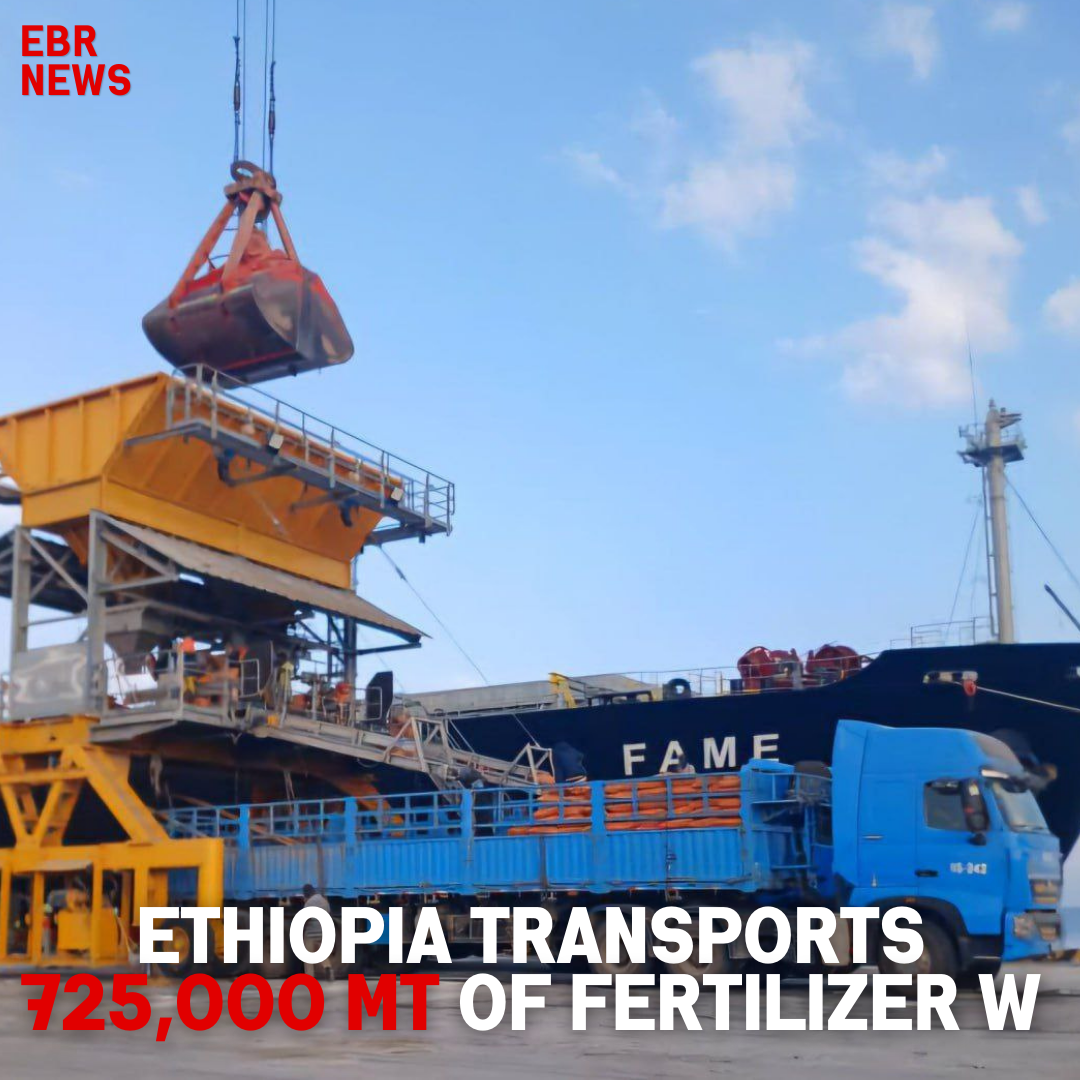
Ethiopia has made significant progress in its fertilizer import strategy, with over 724,965 metric tons (MT) of fertilizer successfully transported into the country. This forms part of the broader plan to secure 2.4 million metric tons (24 million quintals) of fertilizer for the 2025/26 production season, ensuring adequate supplies for the country’s agricultural sector.

By March 12, 2025, a total of 797,463.1 MT of fertilizer had been offloaded from 15 ships at the port of Djibouti. Among these, 9 vessels brought in 512,968 MT of Di-ammonium Phosphate (DAP), while 6 ships delivered 284,495.1 MT of urea.

Of the total amount unloaded, 724,965.2 MT has already been transported into Ethiopia, with the remaining 72,497.9 MT still awaiting transfer at the Djibouti port. The transportation of the fertilizer has been efficiently handled, with dry bulk carriers moving 724,965.2 MT of urea, and rail networks managing the delivery of 610,935.2 MT.

Further shipments are on the horizon, with 227,000 MT of fertilizer—comprising 175,000 MT of DAP from three ships and 52,000 MT of urea from one ship—expected to arrive later this month.


Ethiopian Maritime Transport and Logistics has announced a remarkable performance for the past six months, with a profit of ETB 9.3 billion before tax, marking a 188% increase from the previous year. This impressive result also exceeds the institution’s initial target of 6 billion birr in pre-tax profit.

The announcement was made in the presence of Ethiopian Investment Holding Deputy CEO, Habtamu Haile Michael, and other key officials overseeing the institution’s operations.

Berhane Gebreezgar, Head of the Business and Development Department, shared insights on the institution’s pivotal role in Ethiopia’s trade infrastructure. He highlighted that Ethiopian Maritime Transport and Logistics has been instrumental in facilitating the country’s import and export operations, providing comprehensive logistics services. These include transporting factory products, machinery, vehicles, construction materials, and various cargoes by both sea and land.

In the first half of the year, the institution handled 3.9 million tons of import and export cargo, surpassing expectations. Additionally, the revenue generated from these services reached over ETB 46 billion, exceeding the target of ETB 44.1 billion and reflecting a 99% year-on-year growth.


The Ethiopian Capital Market Authority (ECMA) has announced a one-month extension for publicly held companies to submit required regulatory documents, offering a final opportunity for compliance with the newly enacted Public Offer and Trading of Securities Directive No. 1030/2024.

The extension, granted in response to industry requests, pushes the deadline to April 9, 2025. This move underscores the Authority’s commitment to fostering transparency and investor protection as Ethiopia’s capital market takes shape.

Companies with over 50 shareholders—whether publicly listed or in the process of raising capital—are urged to submit key details about their securities. This includes the total number of shares issued, their valuation, historical offering details, and relevant promotional materials.

ECMA emphasized that failure to comply by the new deadline will have regulatory consequences, with any share issuance by non-compliant companies being considered as occurring after the directive’s effective date of November 14, 2024.

Hard copies of the required documents must be delivered to ECMA’s head office at Minaye Building, Addis Ababa, while digital copies should be sent via email.

The Authority reiterated that this submission does not equate to formal registration of existing securities. Companies will still need to complete the full registration process within a year from the directive’s enactment.


The Ethiopian Capital Market Authority (ECMA) has issued a stern warning to the public about the existence of an unauthorized entity operating under the name Takilo “Investment Bank.” The entity falsely claims to be Ethiopia’s first investment bank providing capital market services, yet it is doing so without the required license, violating both national regulations and investor protection laws.

ECMA has made it clear that Takilo “Investment Bank” has not been granted the necessary license to operate as an investment bank or to offer any capital market services in Ethiopia, as mandated by the Capital Market Service Providers Licensing and Supervision Directive No. 980/2024. The entity is, therefore, operating illegally and is not authorized to engage in any capital market activities.

In accordance with the Capital Market Proclamation No. 1248/2021 and the licensing directive, only entities that are fully registered and regulated by ECMA are allowed to provide capital market services within the country. As a result, ECMA is urging all individuals and businesses to avoid engaging with Takilo “Investment Bank” or any similar entity that lacks proper authorization.

Engaging with these unauthorized providers poses a significant risk to investors, as they are not subject to regulatory oversight that ensures market integrity and protects investor interests. ECMA strongly advises the public to verify the licensing status of any capital market service provider before entering into any agreements or investments.

The authority also calls on the public to remain vigilant, exercise caution, and conduct thorough due diligence to protect themselves from fraudulent activities.


The Ethiopian Investment Board has convened at the Ethiopian Investment Commission (EIC) headquarters today, reviewing ongoing initiatives and making key investment-related decisions.

Among the critical agendas discussed was a proposal from a private investor seeking approval to establish a multi-sector special economic zone with an initial capital investment exceeding $78 million. Following extensive deliberations, the board approved the request and officially designated the project as a multi-sector special economic zone, paving the way for immediate implementation.

In addition to this decision, the board also addressed matters related to the zone’s design, land allocation, and usage, reinforcing its commitment to streamlining investment procedures.

According to the Ethiopian Investment Commission, the board remains dedicated to fostering a competitive and investor-friendly business environment and will continue strengthening its support to the Commission.


The National Bank of Ethiopia (NBE) and the Ethiopian Securities Exchange (ESX) have signed a landmark Memorandum of Understanding (MoU) to enhance the governance and transparency of Ethiopia’s interbank money market using the ESX trading platform.

H.E. Mamo Mihretu, Governor of NBE, emphasized the crucial role of this initiative in modernizing financial markets, improving liquidity, and strengthening monetary policy transmission.

Since its launch in October 2024, the platform has facilitated transactions exceeding 377 billion ETB, marking a significant leap in Ethiopia’s financial sector development. The agreement sets the foundation for enhanced cooperation, risk mitigation, and market integrity, ensuring that the interbank money market operates with efficiency and confidence.

As Ethiopia deepens its financial sector reforms, this collaboration is expected to enhance market confidence, promote transparency, and drive financial stability, positioning Ethiopia as an emerging player in regional capital markets.


The U.S. Department of State has issued an updated travel advisory for Ethiopia, maintaining a Level 3 status—”Reconsider Travel.” This level indicates that the country presents significant risks that travelers should carefully consider before making travel plans. The U.S. government uses a tiered system to categorize countries based on their safety for U.S. citizens, with the advisory levels ranging from 1 to 4.

Level 1, “Exercise Normal Precautions,” is assigned to countries considered generally safe for travel. In these countries, U.S. citizens are advised to stay aware of their surroundings and take basic safety precautions. Countries with a Level 1 status typically experience stable political situations, low crime rates, and minimal health risks.

Level 2, “Exercise Increased Caution,” is issued when there are specific concerns in a country, such as political instability or heightened crime rates, but these factors do not pose an immediate threat to travelers. While these countries are still generally safe, travelers are encouraged to remain informed and avoid specific regions where risks may be present.

Ethiopia’s travel advisory falls under Level 3, “Reconsider Travel,” due to ongoing security risks. The U.S. Department of State highlights concerns over armed conflict and civil unrest in regions like Amhara and parts of Oromia, where clashes between government forces and local militias have caused instability. There are also concerns about crime, including kidnappings, in areas such as Gambela and Benishangul Gumuz. Additionally, border areas with Eritrea, Sudan, and Somalia are flagged due to potential threats from terrorism and landmines.

Countries placed under Level 4, “Do Not Travel,” are considered extremely dangerous, and the U.S. government advises against all travel to these locations. This level is reserved for countries experiencing active armed conflict, widespread violence, or serious health crises that pose significant risks to travelers.

While Ethiopia remains under a Level 3 advisory, officials have repeatedly criticized these warnings, arguing that they misrepresent the current situation and harm the country’s tourism industry.


In a groundbreaking move to elevate Ethiopia’s agricultural exports, the Industrial Parks Development Corporation (IPDC) and Africa Farming Industries (AFI) have signed a Memorandum of Understanding (MoU) that paves the way for large-scale production and export of strawberries and saffron—two of the world’s most lucrative agricultural commodities.

The USD2 million investment, to be established in Bole Lemi Special Economic Zone (SEZ), marks a strategic shift in Ethiopia’s ambition to become a global leader in high-value horticulture. By introducing AI-driven precision farming, climate-controlled hydroponics, and sustainable agricultural practices, AFI is set to revolutionize the sector and position Ethiopia as a premier supplier to international markets.

“Our investment is more than just farming—it’s about positioning Ethiopia on the global map as a producer of premium strawberries and saffron,” said Nassour Mahamat, CEO & Chairman of AFI. “We are bringing cutting-edge technology, sustainable practices, and an export-driven strategy that will benefit both local communities and international consumers.”

Dr. Feseha Yitagesu, CEO of IPDC, emphasized the innovative nature of the partnership, noting that this is the first time the corporation is facilitating such an investment. He underscored that the initiative aligns with Ethiopia’s vision of modernizing its agricultural sector, enhancing exports, and attracting foreign direct investment. “We are fully committed to supporting this project to ensure its success and long-term impact,” he assured.

As a subsidiary of Pluton Invest, AFI has gained prominence since its establishment in Chad in 2020. The company’s AI-powered vertical farming model will enable year-round production, high yields, and strict quality control, ensuring Ethiopia meets the stringent standards of international buyers.


The Tanzanian government has justified its decision to import electricity from Ethiopia through Kenya, highlighting its potential to enhance energy efficiency and address chronic power shortages in the Northern Zone. These outages have led to annual economic losses exceeding Sh32 billion.

Speaking in Kilimanjaro at the inauguration of a water project, President Samia Suluhu Hassan acknowledged public concerns but reassured citizens that the decision was carefully evaluated. She explained that transmitting electricity from the South-Eastern region to the Northern Zone has resulted in substantial energy losses, making the local supply unreliable. Importing power from Ethiopia, she emphasized, offers a more stable and cost-effective alternative.

Government Spokesperson Gerson Msigwa later reinforced this stance, noting that Tanzania’s existing transmission system struggles with long-distance energy losses, contributing to frequent outages. He added that sourcing electricity from Ethiopia via Kenya will help mitigate these challenges and strengthen grid reliability.

The government also pointed out that importing electricity is not a new approach, as Tanzania has previously sourced power from neighboring Zambia, Uganda, and Kenya to supply its border regions. Additionally, the country is positioning itself to participate more actively in regional power trade, including future electricity exports. This aligns with commitments made during the recent Energy Summit in Dar es Salaam, where East African leaders pledged to enhance cross-border energy cooperation.

Source: MOPAWA


Ethiopian Business Review | EBR is a first-class and high-quality monthly business magazine offering enlightenment to readers and a platform for partners.


2Q69+2MM, Jomo Kenyatta St, Addis Ababa

Tsehay Messay Building

Contact Us

+251 961 41 41 41