Faced with a growing fertilizer shortage that threatens agricultural production, Ethiopia is stepping up efforts to enhance its logistics infrastructure, aiming to ensure the timely delivery of fertilizer to farmers before the critical winter planting season.

In a strategic meeting held in Djibouti, Ethiopia’s Transport and Logistics Minister, Dr. Alemu Sime, convened with leaders of key logistics institutions to discuss the pressing challenges and potential solutions for the efficient transport of fertilizers. The meeting underscored the central role of logistics in mitigating the impact of fertilizer shortages that have hampered agricultural activities in the past year.

The Soil Fertilizer Operations Committee, a collaborative initiative spearheaded by the Ethiopian Embassy in Djibouti, was lauded for its successful coordination of fertilizer imports. In a single day, the committee oversaw the delivery of over 18,000 metric tons of fertilizer, a notable achievement that highlights the effectiveness of inter-agency cooperation in overcoming logistical bottlenecks.

However, the issue of fertilizer scarcity remains a pressing concern. Despite a $1.3 billion budget allocated by the Ministry of Agriculture to procure over 2.4 million tons of fertilizer for the current year, Ethiopia continues to face a significant supply gap. The fertilizer supply has failed to meet the demands of regional states, largely due to global market fluctuations and logistical challenges along the Ethio-Djibouti corridor.

In response, the Ethiopian government has prioritized early procurement for the upcoming Belg (short rainy season) and Meher (main rainy season) harvests, which are pivotal to the country’s agricultural output. The Ethiopian Agricultural Business Corporation (EABC), which holds the monopoly on fertilizer imports, is moving swiftly to secure 25 million quintals of fertilizer to meet immediate demand. This proactive step is intended to avoid the delays that have plagued previous distribution efforts.

“The logistics sector plays a vital role in ensuring that we can get fertilizers into the hands of farmers on time,” Dr. Alemu emphasized. “In this season, more than ever, we must ensure that no logistical hurdles stand in the way of food security. We are committed to strengthening our supply chains and resolving any issues promptly.”

While the Ethiopian government continues to address immediate logistical challenges, the role of the Ethio-Djibouti trade corridor remains crucial. Despite efforts to streamline operations, the corridor has faced frequent disruptions, hindering the smooth flow of goods, including fertilizers. The government is now focusing on addressing these disruptions to ensure that transportation bottlenecks do not impede fertilizer delivery.

The Ethiopian Embassy in Djibouti has also played a significant role in facilitating real-time communication and resolving problems that arise along the route. With the winter planting season fast approaching, the government is keen to ensure that farmers have access to fertilizers without delay, which is crucial for maintaining agricultural productivity and food security.




Somalia is considering offering Ethiopia access to a port on the Indian Ocean, a move that could ease tensions between the two nations over Addis Ababa’s long-standing quest for a direct trade route to the sea, according to Bloomberg.

The two countries are in talks, aiming to finalize a framework agreement by June, Somalia’s state minister for foreign affairs, Ali Mohamed Omar, said in an interview with Universal TV on Thursday.

Omar explained that the framework would determine the type of port to offer, the exact location in the Indian Ocean, and the overall cost. His comments followed a meeting in Mogadishu between Somali President Hassan Sheikh Mohamud and Ethiopian Prime Minister Abiy Ahmed.

On his social media page, Prime Minister Abiy expressed his gratitude, saying, “I appreciate the warm and brotherly welcome by President Hassan Sheikh Mohamud in Mogadishu today. We held extensive discussions on a range of areas including peace and security, economy, diplomacy, and the potential to build joint infrastructure.”

Bloomberg reported that spokespeople for Ethiopia’s Office of the Prime Minister and Ministry of Foreign Affairs did not respond to requests for comment.

Diplomatic relations between Ethiopia and Somalia soured in January after Ethiopia announced a deal with Somaliland, a self-governing region that Somalia claims as its own. The agreement included port access and a military base on the Gulf of Aden, alongside an agreement to provide Somaliland with an unspecified stake in Ethiopian Airlines, Africa’s largest carrier. Mogadishu strongly opposed the deal, considering Somaliland part of Somalia.

Abiy (PhD) and Mohamud (PhD) agreed to resolve their dispute by the end of February, under the mediation of Turkish President Recep Tayyip Erdoğan. In the meantime, Somalia has partnered with Turkish construction firm Metag Holding to develop a port in the coastal town of Hobyo, with construction set to begin later this year.


Lamu Port is set for increased activity following a significant agreement between Kenya and Ethiopia, positioning it as a key regional transshipment hub. President William Ruto announced on today that Ethiopia has committed to using Lamu Port for its imports, a move expected to boost trade, create jobs, and strengthen the region’s economy. He emphasized that this agreement aligns with Kenya’s broader strategy to enhance the port’s role in regional logistics and commerce.

As Kenya’s second-largest port after Mombasa, Lamu is a central component of the Lamu Port-South Sudan-Ethiopia Transport (LAPSSET) corridor, which has been under development since 2012. To further solidify its regional importance, President Ruto revealed plans to host regional leaders at the port in the near future. The first three modern berths at Lamu Port are now complete and ready for use, marking a critical step in its operational readiness.

To address the impact of port expansion on local communities, the government has allocated Ksh.1.7 billion to compensate fisherfolk displaced by construction. In addition to port development, President Ruto launched the 468-unit Mokowe Affordable Housing Project in Lamu West Constituency, which is expected to generate employment opportunities for young people while improving housing infrastructure in the area.

Further investments in infrastructure are also underway, with the government committing Ksh.600 million to connect 7,000 households in Lamu County to electricity this financial year. Meanwhile, in Tana River County, President Ruto commissioned the Bura Gravity Canal, which will expand irrigation from 6,000 to 25,000 acres. He highlighted that 70% of the funding for the project came from the government, underscoring agriculture’s critical role in securing food supply, creating wealth for farmers, and reducing dependency on costly imports.

Reaffirming his administration’s commitment to equitable development, President Ruto declared that past discriminatory resource allocation practices are over. He urged Kenyans to reject divisive politics, warning against leaders who exploit ethnic divisions for personal gain. Stressing the importance of national unity, he called on citizens to remain focused on collective progress, reinforcing his vision of Kenya as one united nation working toward shared prosperity.


Ethiopia has secured a $60 million grant from the The World Bank to enhance healthcare services for vulnerable communities in climate-stressed and conflict-affected regions. The grant will support the implementation of the Innovative Systems to Promote Integrated, Resilient, and Enhanced Responses to Women and Girls’ Health (INSPIRER) project.

The agreement was signed virtually by Ahmed Shide, Ethiopia’s Minister of Finance, and Maryam Salim, Division Director for Ethiopia, Eritrea, Sudan, and South Sudan at the World Bank, according to a statement from the Finance Ministry.

INSPIRER aligns with Ethiopia’s Health Sector Development Investment Plan (HSDIP), focusing on climate resilience, digital solutions, and equity interventions to improve health outcomes for women and girls. The project is expected to directly benefit 15 million women and girls in drought-prone regions such as Afar, Somali, and Gambella, while also strengthening healthcare systems nationwide.


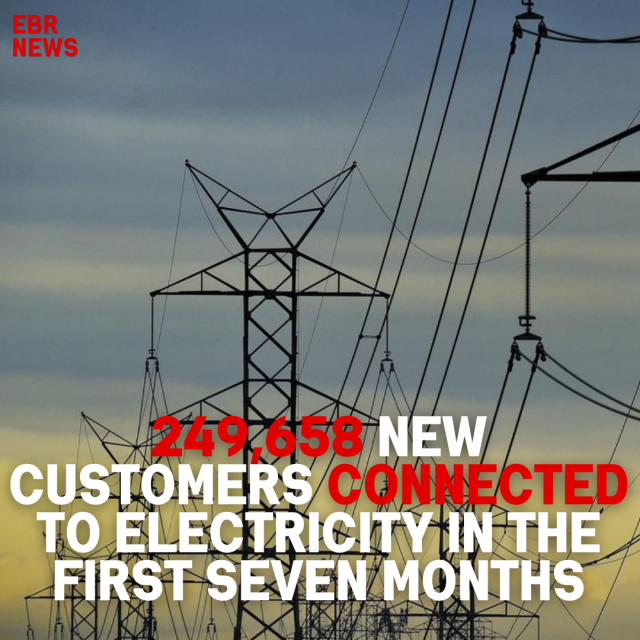
Ethiopian Electric Utility (EEU) has made significant strides in expanding electricity access across the country, achieving a major milestone in the first seven months of the fiscal year. A total of 249,658 new customers have been successfully connected to meters through the EEU’s operation/service centers and the National Electricity Supply Program. This expansion demonstrates the EEU’s ongoing commitment to providing electricity to more citizens and enhancing the national power infrastructure.

In addition to this achievement, the EEU has made remarkable progress under the National Electricity Supply Program, connecting 72 rural kebeles and villages that previously lacked electricity. These communities, spread across various regions of Ethiopia, have now been integrated into the national grid and provided with off-grid solar mini-grid technology. This move significantly reduces the gap between rural and urban access to electricity and brings substantial benefits to these previously underserved areas.

The EEU is also preparing to handle even more energy requests, ensuring that it has the necessary capacity to meet the growing demand for electricity. This is a key part of the ongoing effort to enhance service delivery while ensuring a reliable supply for both new and existing customers.

In terms of infrastructure improvement, the EEU has made substantial progress in repairing, reconstructing, and expanding Ethiopia’s electricity network. A total of 38,855 kilometers of the distribution network were repaired, 3,801 kilometers were reconstructed, and 706 kilometers of new infrastructure were added. Additionally, 941 distribution transformers were upgraded, and 2,000 new transformers with various ratings were installed. These upgrades are crucial in enhancing the country’s power supply and supporting the increased number of connections.

Despite these advancements, power outages remain a challenge. According to Engineer Getu Geremew, Executive Director of the Electricity Service, 47 percent of power interruptions are caused by trees and branches falling on power lines. To address this issue, the EEU launched a nationwide initiative two months ago to clear and trim trees along the power lines, aiming to reduce disruptions caused by environmental factors.

Dr. Brook Taye, CEO of Ethiopian Investment Holding, stated that the organization is committed to eliminating unreasonable power outages. Ethiopian Investment Holding, which oversees more than 20 state-owned enterprises, including the Ethiopian Electric Power Service, identified various reasons for power disruptions, including insufficient infrastructure, technical difficulties, and other operational challenges.

In response, a thorough study was conducted over the past six months to better understand the root causes of the outages. Based on the findings, a medium-term plan has been developed and is already being implemented. This plan focuses on improving the operational efficiency of the electricity network and aims to significantly reduce power outages, ensuring more consistent and reliable electricity delivery to Ethiopians.


IMG-20250217-WA0005.jpg

According to the National Bank of Ethiopia (NBE), Ethiopia’s inflation rate has seen a significant decline, . The NBE reports that the annual inflation rate fell from 29.4% in January 2024 to 15.5% in January 2025, marking a notable decrease of 13.9 percentage points. This improvement is attributed to a drop in food inflation by 16.6 percentage points and a reduction in non-food inflation by 10.2 percentage points. The central bank credits these changes to the transition to a market-based exchange rate and the implementation of tighter monetary controls, which are helping to stabilize price pressures.


national-bank-of-ethiopia.jpg

The National Bank of Ethiopia has announced a substantial decrease in the country’s inflation rate, which fell to 15.5% in January from 29.4% a year earlier. This represents a decline of 13.9 percentage points, with food inflation decreasing by 16.6 percentage points and non-food inflation by 10.2 percentage points over the same period. The sharp decline signals that recent economic policies, such as the transition to a market-based exchange rate and tighter monetary controls, are beginning to stabilize price pressures. However, concerns about the cost of living persist for many households.


IMG-20250212-WA0001-1280x852.jpg

Ethio Telecom has shown significant growth in the first half of the 2024 fiscal year, with notable financial results and investments in infrastructure and service expansion. The company generated ETB 61.9 billion in revenue, achieving 90.7% of its target. Revenue from international services totaled ETB 64.4 million, while mobile data usage increased by 48.8% to 642.2 billion MB, and mobile voice usage grew by 12.7% to 83.6 billion minutes. The telebirr platform registered 5 million new users, bringing the total to 51.5 million. It facilitated ETB 1.03 trillion in electronic money transactions during the period, contributing to a cumulative total of ETB 3.58 trillion since its launch.


Ethiopian Business Review | EBR is a first-class and high-quality monthly business magazine offering enlightenment to readers and a platform for partners.


2Q69+2MM, Jomo Kenyatta St, Addis Ababa

Tsehay Messay Building

Contact Us

+251 961 41 41 41