
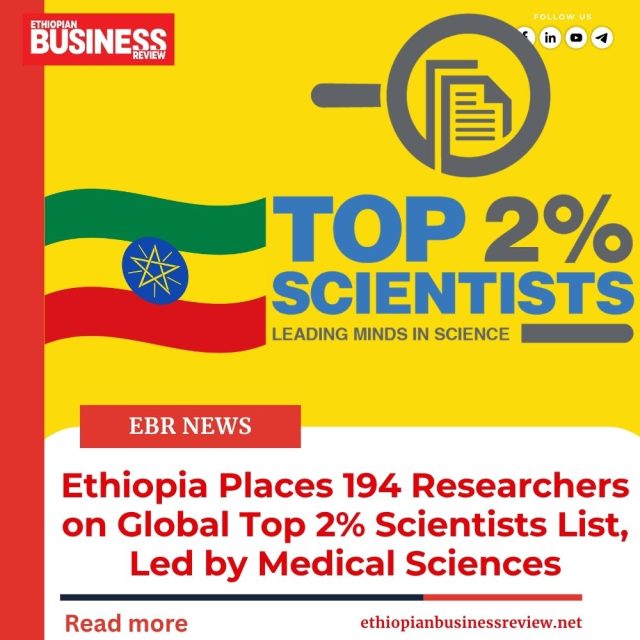
Ethiopia Places 194 Researchers on Global Top 2% Scientists List, Led by Medical Sciences
Betegbar Yaregal
#EBR_News Oct 12, 2026
A total of 194 researchers affiliated with Ethiopian institutions appear in the single-year ranking of the Stanford/Elsevier “Top 2% Scientists” database, according to an Ethiopian Business Review analysis of the dataset.
The figure is about 0.08 percent of the 236,313 authors in the table. It shows a growing but still narrow base of internationally cited research in Ethiopia, and one heavily concentrated in health sciences.
The database is compiled by John Ioannidis of Stanford University and colleagues using Elsevier’s Scopus data. It is a citation dataset rather than an award, DATAMETA LAB, which runs a searchable version of the list, said in an explainer. Scientists are ranked by a composite score that weighs citations, co-authorship and author position.
A researcher is included if they are in the top 100,000 overall or in the top 2 percent of their subfield. The single-year table counts only citations received in one calendar year, so it favours early and mid-career researchers with recent, well-cited work.
By institution, Addis Ababa University has the most entries with 25, followed closely by the University of Gondar with 24 and Bahir Dar University with 23. Haramaya University has 15, while Jimma, Mekelle and Hawassa universities have eight each.
In total, the entries are spread across 51 institutions, including newer universities such as Injibara, Wolkite and Debre Tabor, as well as research bodies such as the Armauer Hansen Research Institute, the Ethiopian Public Health Institute and the International Livestock Research Institute in Addis Ababa.
The subject mix is lopsided. According to the dataset’s field classification, 134 of the 194 entries, or roughly 69 percent, fall under clinical medicine, with 90 listed primarily under general and internal medicine and 17 under tropical medicine.
Agriculture, fisheries and forestry follow with 19 entries and chemistry with 10, while engineering, information technology and mathematics together account for only eight. Much of the health-sciences strength reflects large collaborative studies on disease burden and maternal and child health, where papers attract many citations.
Only 25 of the Ethiopian entries rank within the overall top 100,000, with the rest qualifying through the top 2 percent of their subfield. The best-placed entry is Azamal Husen of Wolaita Sodo University, a plant biologist ranked 4,603th, followed by Tadele Assefa Aragaw of Bahir Dar University at 9,845th and Woldeamlak Bewket of Addis Ababa University at 23,475th.
Among the African countries EBR compared, Ethiopia trails Egypt with 1,106 entries, South Africa with 976 and Nigeria with 291. It is ahead of Morocco with 133 and Kenya with 69.
The ranking also depends on Scopus coverage, which can miss work and split author profiles, and its compilers caution that not being listed does not mean a researcher does not do good work.
The headline figure needs careful reading. About 11 entries appear to be foreign nationals working at Ethiopian institutions, including Azamal, so the number of Ethiopian researchers is somewhat lower.
Still, 107 of the 194 began publishing in 2015 or later, which points to a young research workforce emerging from the country’s fast-expanding university system.
 Betegbar Yaregal