

Oromia Bank’s Pre-Tax Profit Rises 49% to Birr 3.82 Billion in 2025/26
#EBR_News Oct 10, 2026
Oromia Bank S.C. has reported a 49% rise in profit before tax to Birr 3.82 billion for the 2025/26 fiscal year, up from Birr 2.57 billion a year earlier, according to its annual report.
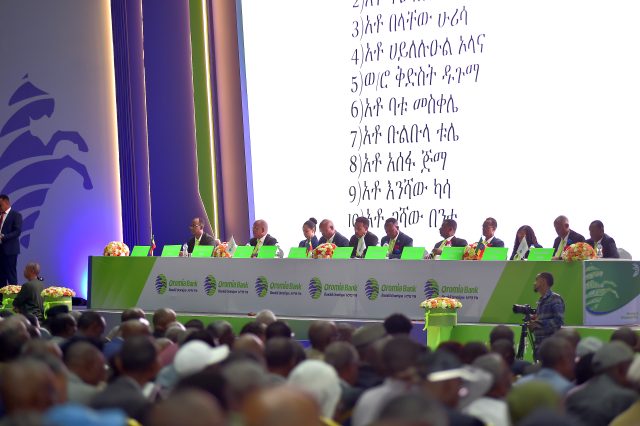
The bank disclosed the results on Saturday at its 17th Ordinary and 6th Extraordinary General Meetings of Shareholders, held at the Addis International Convention Center in Addis Ababa.
The report shows that the pre-tax figure exceeded the bank’s own target of Birr 3.59 billion by 6.4%. Net profit after tax stood at Birr 2.84 billion, a 44% increase on the previous year, following an income tax charge of Birr 980.7 million. Earnings per share rose to Birr 386 from Birr 297, the report indicates.
The bank attributed the performance to income growing faster than costs. Total income rose 23% to Birr 15.24 billion, which the bank said was 99.9% of its annual target, while total expenses grew 17% to Birr 11.42 billion.
“The fact that our income pace above expense… signifies healthy income and expense structure,” said Teferi Mekonnen, the bank’s chief executive officer, in his message to shareholders.
The report also shows that interest income from loans and advances remained the largest earner at Birr 10.05 billion. Other local income rose 213% to Birr 1.89 billion, while fee and commission income fell 19% to Birr 2.45 billion.
The balance sheet expanded alongside earnings. Total assets grew 24% to Birr 105.7 billion and total deposits rose 24% to Birr 88.1 billion, while loans and Interest-Free Banking (IFB) financing increased 28% to Birr 56.2 billion.
Paid-up capital rose 14% to Birr 7.8 billion, lifting total capital to Birr 14 billion. The non-performing loan ratio was 2.43%, below both the bank’s 2.75% target and the 5% regulatory limit, according to the board chairperson’s statement. Return on equity was 37.5%, slightly below the 38.46% recorded the previous year.
Assefa Seme (PhD), chairperson of the board, said in his statement that the bank’s deposit growth reflected continued depositor confidence and its resilience in mobilising resources.
He noted that the economy is projected to grow by 9.2% in 2026 and 7.9% in 2027, but warned that conflict-related disruptions in the Middle East could hit commodity-importing economies with pre-existing fragilities, such as Ethiopia, harder than advanced economies.
Assefa said the board would remain committed to guiding the bank through a “dynamic, difficult, and uncertain environment”. He listed stronger digital capabilities, human resource competencies, prudent risk management and governance, and compliance with National Bank of Ethiopia directives as the board’s priorities.
The report was not uniformly positive. Foreign currency mobilisation fell 19.99% to USD 262.65 million from USD 328.25 million, with inward transfers dropping 69.09% and export earnings declining 31.9%. Forex dealing, by contrast, rose sharply to USD 106.89 million.
Teferi said foreign currency generation would be an area of “renewed focus and radical change” in the new fiscal year. The bank also cited cash shortages, foreign exchange scarcity and rising operating costs as challenges during the year.
On digital banking, the bank reported that digital customers rose 23% to 7.01 million, while service outlets, including ATMs, POS terminals, agents and QR points, grew 117% to 28,435.
The bank said it launched the Abbaa Fardaa Remit platform for diaspora transfers and introduced Oro Visa Classic, Gold and Platinum cards in partnership with Visa and Premier Switch Solutions. Its Milkii digital lending platform has surpassed 150,000 users and facilitated more than Birr 1 billion in lending.
Teferi, for his part, told shareholders that the bank had revitalised its business momentum during the year, with progress in profitability, resource mobilisation, customer growth, capital strength and asset quality.
He described the domestic outlook as positive, pointing to anticipated inflation of 12% in 2026 and continued improvement in export earnings.
Looking ahead, Teferi said the bank’s priorities include business growth, digital penetration, cost optimisation, superior service delivery, enhanced cybersecurity and sustainable asset quality.
He said these would be pursued under the bank’s fourth corporate strategic plan, which rests on five pillars: accelerating digital transformation, driving business growth and resource mobilisation, empowering a high-performing workforce, putting customers at the heart of the business, and disciplined cost optimisation.
The board has asked shareholders to approve the distribution of Birr 1.96 billion after reserves and other deductions.
The bank also reported progress on its infrastructure, with its transitional headquarters at Goma Kuteba at 60.5% completion and the first two phases of the Gelan Excellence and Convention Center finished.
 Betegbar Yaregal
